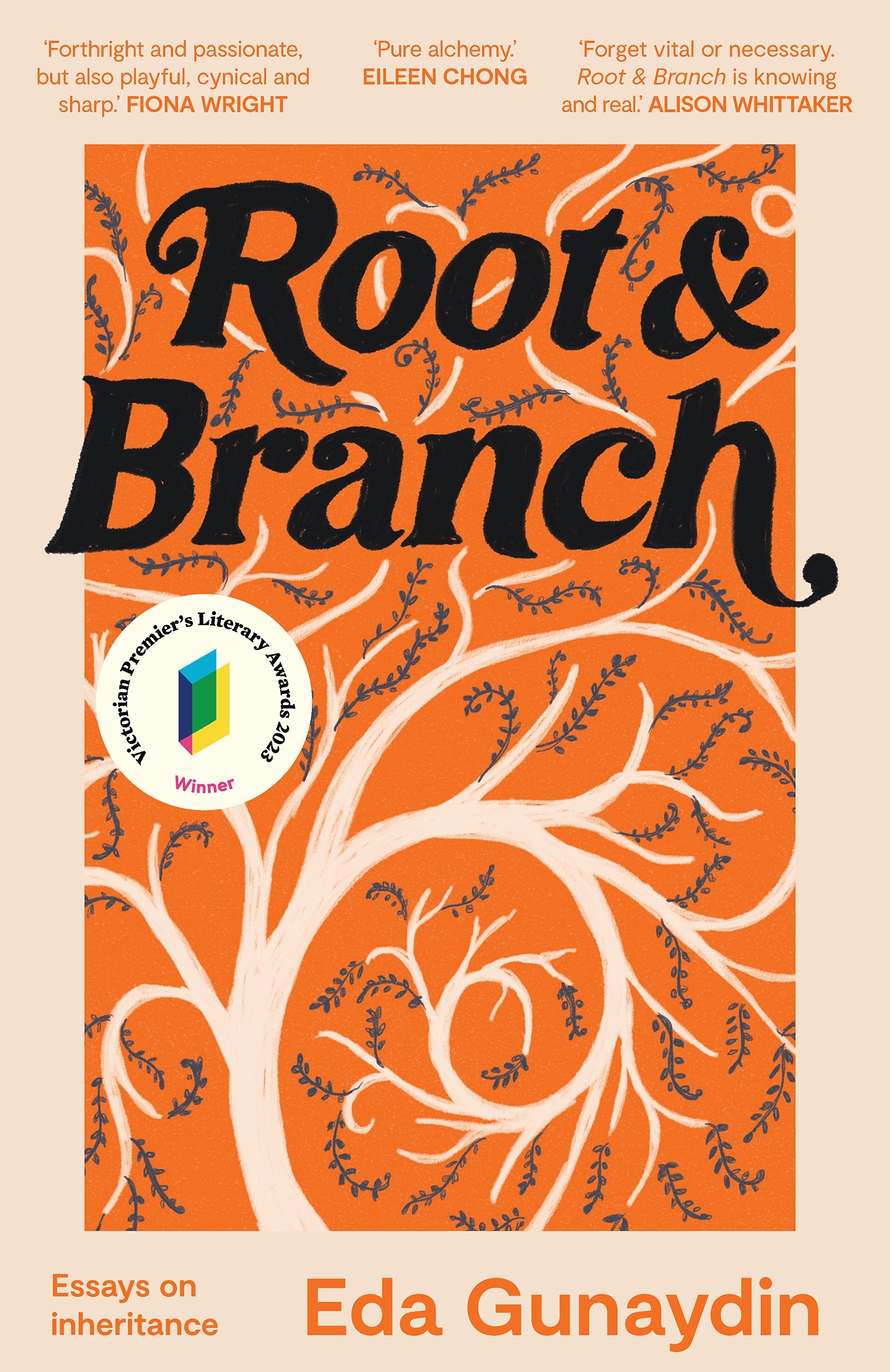
In this collection of essays Turkish-Australian writer Eda Gunaydin excavates her life in the search for origins. Gunaydin begins in a kebab store in Blacktown, an origin story of sorts that introduces many of the concerns that will surface throughout the collection: food, body, class, family, patriarchy, Turkishness, Western Sydney, labour, mental health. Her first published short story, Meat, was about “the rage and absurdity of life under capitalism, and our potential to push back against it.” In Root And Branch she expands on that rage and absurdism.
Across 12 essays she takes as her topics the (re)gentrification of Parramatta, Sydney’s “Second City”; anxiety; rape culture; dieting and bodies; brunch and fast food; her father’s family; health inequities; the pleasures and perils of literature; the desire to confess; the desire to have children (or not); and her yearning for Turkey. But none can be so easily reduced as that. Only So Much, for instance, begins as a typical drunken night out, but becomes an exploration of gender and power. She watches a male bartender taking ages to serve female customers he wants to flirt with, while ignoring her:
The guy tending the bar takes a full ten minutes, I time it, to create a martini with a lemon twist. What’s the twist? That you’re a cunt? Then I dwell on the tender speed with which he penetrates each olive.
These essays are not easy to contain; they meander and digress in delightfully free ways, full of anecdote, aside and passing comment. In each Gunaydin sketches in personal details, but this is not the “tell-all” memoir she wrote and abandoned due to her “fear that we are increasingly losing the moral or political edge that made literary confession not the end, but the means to greater critique”. Gunaydin mentions some of the awful things she and her family have experienced, but is more concerned with their devastating effects:
For a very long time I didn’t notice that I didn’t notice colours. Fellow havers of complex trauma or depression may relate … Then I took enough MDMA … and sat through enough therapy that one day I was walking down Croydon Street, heading to Petersham Park, and I noticed that jacaranda trees are fantastically purple, and the dead lorikeet that I saw on the road, while dead, was fucking green and its splattered guts were really very red.
Throughout Root And Branch Gunaydin examines the material forces that shape her experiences. She walk through a university campus or drink a beer without exploring the labour involved and the inequities that result, such as the 19 year life expectancy gap between the Sydney suburbs where Gunaydin and her partner Justin were born. It’s an invigorating approach that renders a world become too familiar and unquestioned uncanny. On buying a coffee in Western Sydney from a cafe chain from the inner city, she writes:
The addition of latte art suggested care and value, for me and my impressive feat of owning four dollars. Latte-sipping is over-saturated as a metaphor of ridicule by now, but I do believe it has something to say about the passage I had completed through the velvet ropes of labour relations.
Gunaydin describes those passages her family has passed through, from office jobs in Turkey, to her father becoming a builder in Australia, to her jobs in hospitality and later in arts administration. She wrestles with a kind of survivor’s guilt of having a middle-class job and the privileges (or otherwise) that come from working as a writer. Root And Branch is a compelling search for answers to the question of “why am I the way that I am?”
Gay rating: 3/5 for discussions of sexuality and some queer themes.
Discover more from The Library Is Open
Subscribe to get the latest posts sent to your email.
 The Library Is Open