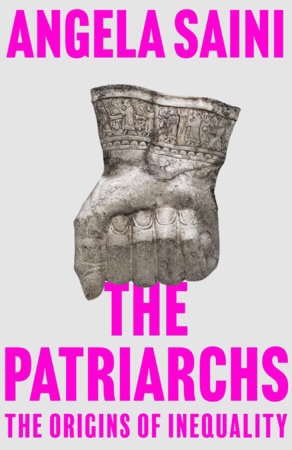
Whether patriarchy is or isn’t “natural” is rather beside the point given the harm it does. But given that patriarchy’s naturalness or inevitability is often used in its defense, in this investigation journalist Angela Saini treats this as a serious question worth a serious answer.
She approaches that question scientifically, through disciplines as diverse as archaeology, sociology, anthropology and history. Science is predictive, and any explanation of patriarchy ideally should be able to predict in what circumstances it emerges. The world of course is much messier than that, and something as complicated as patriarchy — a power structure, a culture, a sociological phenomena — is particularly difficult. Saini shows however that the answers that are emerging are fascinating, largely underreported, and encouraging, depending on where you sit on the possibility of radical social and economic change.
She gets out of the way early that there is nothing inherently biological about patriarchy. This is proved by comparisons between humans and our closest ape relatives, and by studying the immense diversity of human social structures. Patriarchy undeniably exists in both, but there is no one thing that consistently predicts when it emerges.
Saini pursues patriarchy through history, taking as case studies moments when male domination came into conflict with other ways of organising society: the colonisation of the Americas, ancient Mesopotamia, classical Greece and Rome, the communist revolutions of the 20th Century and the 1979 Iranian Revolution. These are not straightforward. Athens, beacon of democracy, was much more patriarchal than sister city Sparta, yet is celebrated for its democratic values. The early feminists in the US lobbied for greater rights for housewives — but not Indigenous women or working women (a throughline in The Patriarchs is how so infrequently feminism really does what it says and includes all women). In doing so Saini demonstrates that “patriarchy, far from being a return to the past, [is] in fact being constantly remade in the present”. She also shows that “social change rarely happens suddenly without resistance”.
Patriarchy as we understand it today is not one thing, but a collection of practices of male domination that have come together into a particular toolkit, including patriliny (the passage of power down male descendants) and patrilocality (the movement of wives and property towards a husband’s place of birth), and gender becoming salient. Gendered division of labour, for instance, seems to be unusual in human history, even in societies practicing patriliny or patrilocality.
In the exhilarating The Dawn Of Everything David Graeber and David Wengrow pulled up short when it came to explaining the origins of male domination. Saini picks up where Graeber and Wengrow left off. The Patriarchs does offer an idea of why and how patriarchy emerges (it involves the formation of states and the need for increasing populations of male soldiers to defend borders), but Saini resists a simple narrative. In fact The Patriarchs above all is a book-length argument against simplification. Wondering at why sci-fi stories often replicate patriarchal power structures, she notes:
In a galaxy of alternative worlds, there are imaginary ones, the ones we see in science fiction. But none are as radical as the ones that are real.
What we call patriarchy may be uniquely destructive, but it is also pretty strange, or at least as strange as any other way of organising society, even if it has become dominant today through colonisation and globalisation. Saini’s greatest achievement then may be reminding us of that strangeness, showing us that it isn’t inevitable or necessary.
Gay rating: 1/5 for brief discussion of how queer people are affected by patriarchy.
Discover more from The Library Is Open
Subscribe to get the latest posts sent to your email.
 The Library Is Open
2 Comments