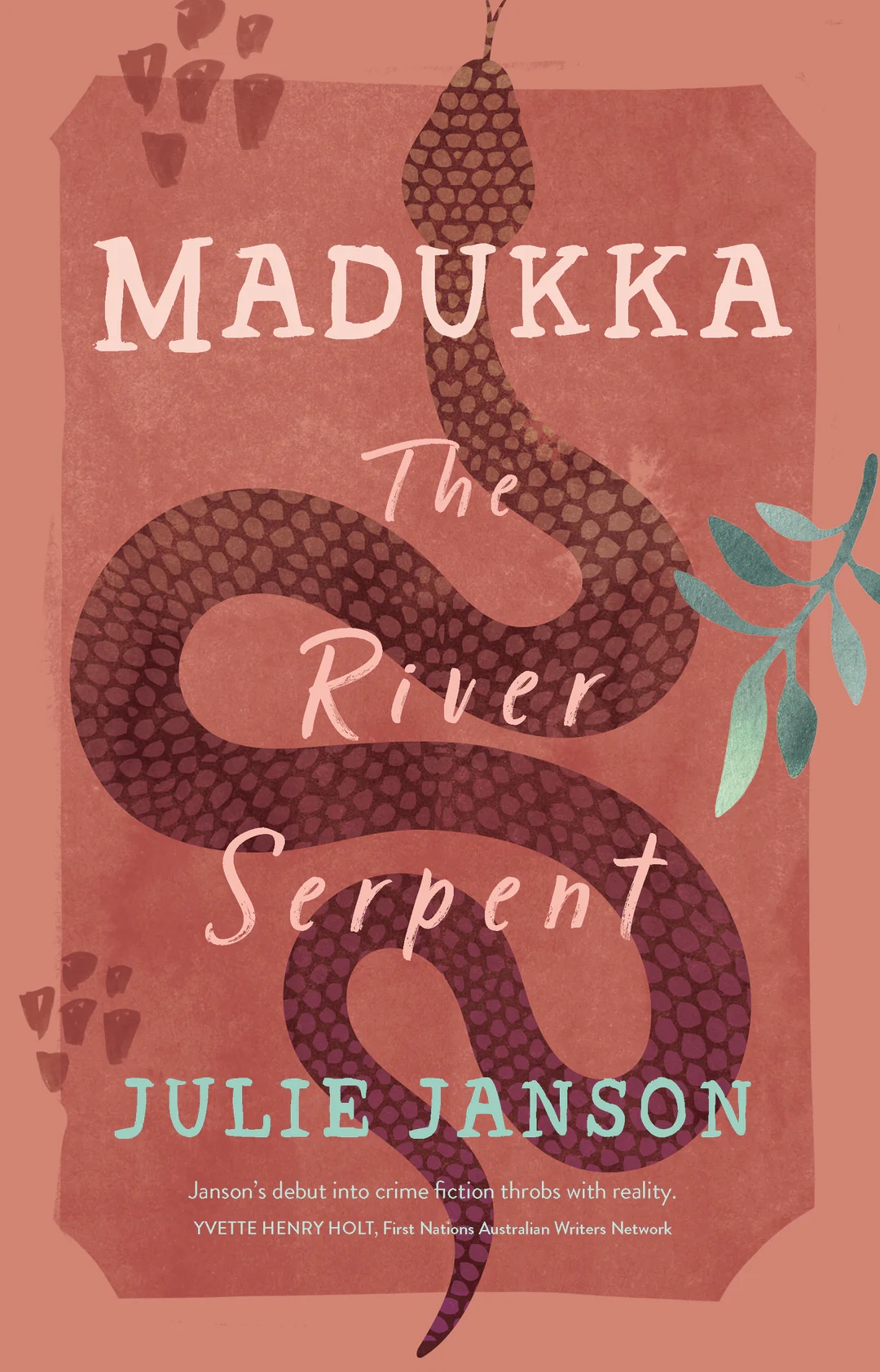
This unsettling crime novel takes place in the fictional town of Wilga, Ngyiampaa Country, on the Barka or Darling River in western New South Wales. It’s a place haunted by colonial atrocities, “the soil full of human fragments, skin and hair and terror and murder … it was a kind of stinking trickle, a miasma oozing from the grey earth.” That violence has continued in into the presence in different forms. “It used to be all rural, sheep mostly,” Janson writes, “all gone now. It’s cotton and security firms.” Those cotton firms are pillaging the river for irrigation, leading to environmental catastrophe. The firms pay gang members embroiled in drug trafficking for security. The money seems to flow freely from business to politics to crime.
Into this febrile atmosphere steps Aunty June, private investigator with a Certificate III, “thirty hours, online”. At the beginning of the novel, the inauspicious date of January 26 (each chapter is dated, and days significant for Aboriginal people are noted), June learns of the disappearance of her young cousin Thommo, an activist and small-time trafficker. Convinced by visitations from his goonge (ghost) that he has been murdered, June sets out to uncover the truth.
The suspects are legion and obvious from the start: the old cop Blackett, the gang member Bam Bam, the corrupt councillor Wright. In the meantime she and family (brother William, sister-in-law Merle, niece Araña and uncle Jack) continue to organise for water rights. June’s investigative technique amusingly largely involves her going around variously asking townsfolk point blank if they killed Thommo. She questions all she can, but her investigations are frustrated for much of the novel, and little new or useful information comes to life, leading to a sometimes uneven and repetitive read. But issues come to a head with the involvement of Steve, Araña’s dashing love interest and a budding young Aboriginal leader, flipping the novel into a tough portrayal of the ongoing crime of colonisation.
The real crime it turns out is not the specific killing of Thommo, but the violence of the state, and the institutions that perpetuate its oppression of Aboriginal people like the police. Some of the unevenness is ironed out with the realisation that there is no single guilty individual; this is a guilty system. In an afterword Janson writes that the novel was built upon her 1990s play Gunjies in response to the deaths in custody Royal Commission, and the novel’s strongest sections show how police violence operates at a personal level, including how it corrupts the officers themselves, and the agonising fight for justice in a system stacked against Aboriginal people. She economically evokes the racial inequalities in the town:
It was a real outback hotel, and a real outback place of segregation and blatant racism. The Aussie way. There was no particular sign to indicate this apartheid, just some jokes in the form of cartoons, all dog-eared and stuck to the wall above the bars.
That’s not to say the novel doesn’t have its fun. Janson has a talent for a pithy characterisation, the councillor Wright “a big swinging dick with dandruff on his shoulders”, or old Uncle Jack who “needed care as an Elder; they kept an eye on him, as he sometimes received TV messages from spaceships or Mossad.” The town and region is richly evoked and the dialogue has the cadence of the theatre. It’s also joyfully horny, with June lusting after many of the town’s handsome men and women, and having a few steamy encounters with a morally questionable character — and who hasn’t lusted after a bad boy?
Gay rating: 2/5 for minor queer characters and queer themes.
Discover more from The Library Is Open
Subscribe to get the latest posts sent to your email.
 The Library Is Open