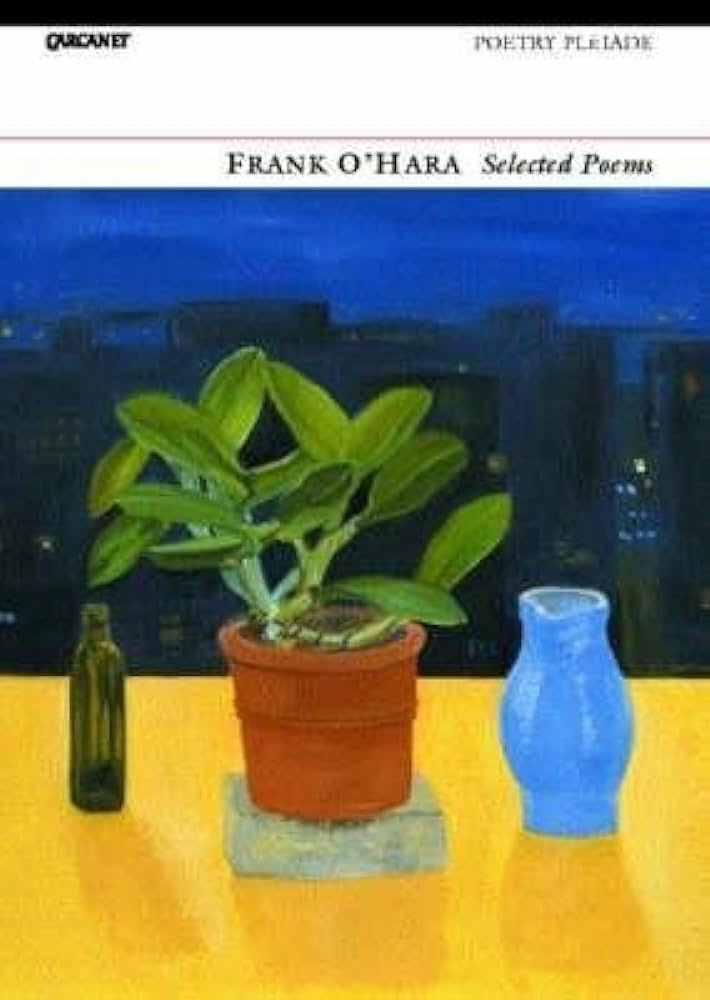
“Everything is in the poems,” Frank O’Hara writes in the manifesto that introduces this selection, in which he describes and claims to invent a new movement called “personism”:
to address itself to one person (other than the poet himself), thus evoking overtones of love without destroying love’s life-giving vulgarity.
By writing such personal poems, “the poem is at last between two persons instead of two pages”. It is a very apt description of reading O’Hara’s poetry, which can feel a little like eavesdropping on a conversation between intimate friends, or finding a coded letter.
Donald Allen selects 140-odd poems here, arranged roughly chronologically, although dates and sources are not noted, revealing how O’Hara’s poetic interests waxed and waned. Many of the earlier poems are resolutely surreal, full of non sequiturs, reaching an early apotheosis in Second Avenue, an immense rendering of history personal and national, absurd and grandiose:
The mountains had trembled, quivering as if about to withdraw,
and where the ships had lined up on the frontier was waiting for
the first gunshot, a young girl lunched on aspergum. A cow
belched. The sun went. Later in the day Steven farted.
He dropped his torpedo into the bathtub. Flowers. Relativity.
Later poems are more explicitly addressed to various lovers, like the much-cited Having A Coke With You, but this selection reveals that while O’Hara’s poetry evolved over the years its inherent style and interests were also present throughout his life (he died age 40 in a motor vehicle accident). Pervading interests include New York and its society (O’Hara was a curator at the Museum of Modern Art and included among his close friends numerous artists), society gossip, love, the limitations of representation. They are resolutely queer, and frank about sex and lovers. “I sometimes think poetry/only describes”, he writes in John Button Birthday, and he references throughout an envy of painting, saying he “would rather be/a painter, but I am not” (Why I Am Not a Painter) and later confesses “I think I’m ‘in love’ with painting” (Adieu to Norman, Bon Jour to Joan and Jean-Paul), as if painters have more direct access to what he yearns for.
O’Hara laments the materiality of things, his poems littered with proper nouns and objects. He “feels the noise of art abate/in the the silence of life” in A Young Poet, and his poems are indeed rather noisy, a cacophony of the streets and conversation as if trying to evoke by contrast the thing that lies beyond words. Weather and colours appear frequently, the poems’ most obvious allusion to the Modernist painters O’Hara lived and played among. “How terrible orange is/and life”, he writes in Why I Am Not a Painter. Meditations in an Emergency explains some of his feelings towards the colour blue, which appears frequently. “Vague blue,” he writes of his eyes which, “change all the time; they are indiscriminate but fleeting, entirely specific and disloyal, so that no one trusts me”:
I’m bored, but it’s my duty to be attentive, I am needed by things as the sky must be above the earth.
Blue then is the all-encompassing, the mutable, the closest the material comes to the thing that can’t be captured in words. Perfectly undercutting that seriousness, the poem also contains the excellent line, “Heterosexuality! you are inexorably approaching. (How discourage her?)”.
O’Hara’s poems can often be obscure, but the words are never weak or loose. An intriguing phrase catches at the mind, but only briefly, because the next one confounds it. I expected gossipy, frothy poems, but there’s a profound streak of melancholy and yearning, or “the movingly/alternating with the amusingly” as he describes in Post the Lake Poets Ballad:
I think of myself
as a cheerful type who pretends to
be hurt to get a little depth into
things that interest me
The rapid tonal shifts often meant I found that only sporadically do O’Hara’s poems feel complete in themselves; conversely reading a whole selection of his body of work is very rewarding. One of those complete poems is In Favour of One’s Time, an uncharacteristically lyrical and focused poem with religious imagery. “It’s …pretty hard to remember life’s marvelous,” he begins, before contemplating the things that make it so, above all love:
love assuming the consciousness of itself
as sky all over, medium of finding and founding
not just resemblance but the magnetic otherness
that that that stands erect in the spirit’s glare
and waits for the joining of an opposite force’s breath
“We live outside his garden”, O’Hara concludes, and in his poetry he constructs his own riotous world beyond the rules.
Gay rating: 4/5 for queer relationships and sex.
Discover more from The Library Is Open
Subscribe to get the latest posts sent to your email.
 The Library Is Open