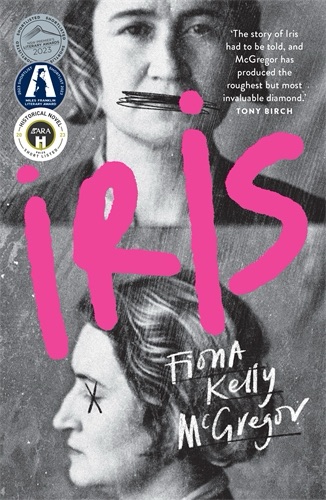
Iris begins with a real police file. It’s 1937 and Iris Webber has been taken in for the murder of a man in Sydney. She’s 31 and been in and out of gaol for a variety of petty reasons, mainly busking. How did the murder happen? And why? Those are the questions that drive this vividly drawn portrait of a woman and of 1930s Sydney.
To find out the answers we need to hear from Iris herself, as she tells the story of her life, from her childhood in inland New South Wales, her marriage at at 19 to the feckless fettler Ned, and her eventual escape to to the slums of inner Sydney where she meets a rogue’s gallery of sex workers, gangsters and queers. Iris is essentially a fictional autobiography, a filling in of the blanks in the historical record, which is, because of Iris’ encounters with with criminal justice system, mainly police and court records, or sensationalised media reporting. This is a problem for marginalised people throughout history — poor, racialised, and, in Iris’ case, queer and a woman — that the historical record is constructed largely by the systems that are least equipped to realise their humanity. Iris then is partly a work of historical justice, as McGregor imagines the life of Iris in all its fullness.
And what a life. With Iris’ voice and character McGregor had achieved something remarkable, a fusion of contemporary and historical vernacular that is recognisable but also not; Iris is scattered with obsolete terms that give a contemporary reader pause but are chucked around by its characters as only people who live them can. Many of the words for queer people are decidedly pejorative, but also sort of endearing; I think you could almost make the case for bringing back “royalies” and “tootsies”.
Iris is a hot-headed lover and fighter, smart but often impulsive, although more often just trying to survive. When she takes a shot at Ned after he’s scorned her once to many times, she describes the heady feeling, “the blood rushed to my cunt”. Later in Sydney when she pragmatically takes up sex work she describes sex with men as “no worse than burning yourself on the stove or getting kicked by a cow when your hands are too frozen to milk”. Later still when she discovers the pleasure of women in some of the best sex scenes recently committed to the page she confesses the turmoil of hearing the words for queer women:
I’d heard such things all my life but now they felt different as though I was now inside the words. And I hated them.
But she also comes to enjoy the power and pleasure of playing with the performance of her gender, “I finally understood how men felt up on their pedestals disposing flattery.”
Of all the criminalised activities that Iris gets tied up in — consorting, busking, begging, “tea-leafing”, “lurks” — her queerness is the most illicit, almost unspeakably so (even though sex between women was technically not illegal, it was beyond the pale for society at large). There’s a circularity to Iris’ and her friend’s (and enemy’s) lives, that of the relentless exposure to the criminal justice system, where power is exercised arbitrarily and notionally in the name of protecting wealth (with the bonus of keeping labour cheap). The characters of Iris go in and out of gaol like a hotel revolving door, are constantly at risk of being harassed and assaulted by the police, have to navigate the complex dance of corruption, alliances and favours between the criminal leaders like Tilly Devine and Kate McNaught and the law.
Iris observes her surroundings forensically, bringing Sydney to life:
As as kid I’d loved those advertisements … that showed Sydney to be all sunny beaches and tanned youth. But it wasn’t like that once you were here. It was cold and damp and the people idled about anxious and thin. Who could afford to go the beach anyway? Nellie and Guido used to go to the Dom baths, more to tea-leaf than to swim. See them tearaways diving into Blackwattle Bay, wouldn’t get a wash any other way. One got run over by a boat, didn’t survive the night. It was busy down there. You could hear the clank of cranes unloading ships, coal thundering into goods carriages, grain by the ton rushing into that silo bigger than St Mary’s.
Like being on the streets you’ve got to keep your wits about you as characters are introduced (and offed) with abandon. McGregor’s pacy prose wonderfully conjure chaos and drama, whether on the streets or in the courtroom:
Secrets could be fun. Kathleen turned her trial [for the shooting of Bill “Smillie”] into a circus saying she’d drunk the Lysol as she was in a state of distress because her husband had left her. She claimed the night that Bill was shot she’d been in Malabar with her mother listening to the radio. Her mother testified this was true then fainted and had to be carried from the court. Roach [lawyer] called Smillie as a witness and then Smillie stuck to his story of being shot by a big man in Redfern. I pictured Kath at Christmas getting roaring drunk laughing about it all …
Like Peter Carey did for Ned Kelly, in Iris McGregor creates a mythology fit for an Australian rogue.
Gay rating: 5/5 for queer characters, themes, relationships and explicit sex.
Discover more from The Library Is Open
Subscribe to get the latest posts sent to your email.
 The Library Is Open
1 Comment