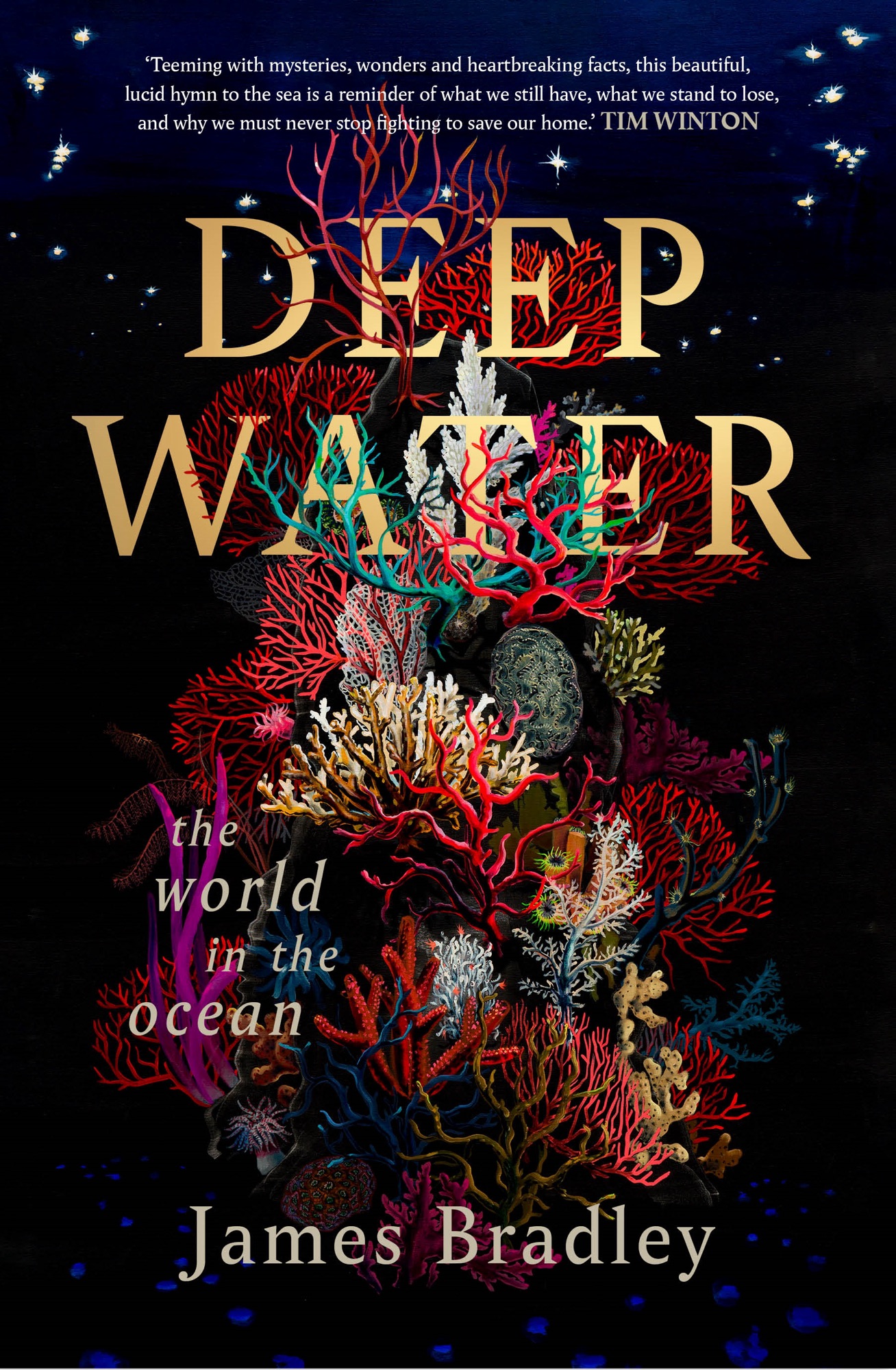
How do you tell a story as big as the ocean? Herman Melville needed over 200,000 words, and that was just whales. James Bradley manages to go deeper and further in this nimble and intimate account of the thing that makes Earth the blue planet. It is of course not a complete account of the ocean. Singular, because truly all the oceans are connected, but also because ocean is a singular idea, one that has provoked and tempted presumably since people first laid eyes on it (which, Bradley notes, was at least before a million years ago when our Homo erectus cousin-ancestors made crossings to islands).
Instead Bradley charts a potted course through the way people relate to the seas, drawing primarily on Western science but also philosophical and literary traditions, and the knowledge of other peoples. So in the chapter fittingly titled Beginnings Bradley discusses not just how water arrived on Earth (a mix of comets and water that is inherently part of the Earth’s sublayers and is still moving upwards in the exquisitely named process of “mantle rain”), but how the ocean is there at the genesis of so many things human, whether in Hawai’ian knowledge or Freud’s psychoanalysis, the place where the boundary between the self and world collapses.
Subsequent chapters ponder the fraught and racist history of swimming, the movement of people and animals over and through water, the use of sound animal- and human-made, the recent appreciation (by Western science) of the complex ways of being in the ocean. Others wonder at the habitats of the ocean — the coast, reefs, Antarctica, the deep — and still more hone in specifically on the ways we have transformed the seas, whether through freight, nuclear testing, plastic pollution or fishing.
Bradley warns against the instinct to “transform the ocean and water into an idea rather than a real place, stripping out its particularity and reducing it to a philosophical concept”, and there are particularities and specificities in abundance: astonishing, gratifying, wonder-inducing (did you know the Globe Skimmer Dragonfly migrates across the Indian Ocean from Africa to India?!). Nonetheless he finds in these themes a unitary history. The ocean, he posits and demonstrates pretty much inarguably, is inextricably bound to the origin of planetary woes, beginning with the expansion of European empire in the 15th Century. From there events snowballed like the feedback loops that are ensuring the destruction of Antarctic ice sheets — in seemingly quick succession emerged slavery, capitalism, fossil fuel trade, all speeding up and intensifying in the aptly named Great Acceleration following World War II to produce the contemporary state of environmental polycrisis and global inequity.
This is a moral and philosophical project that builds on the work of those like Amitav Ghosh, challenging the Western intellectual tradition and “the imperial expansion and colonial violence out of which is grows” that sees us so brutally separated from nature; ideas around time, being human, intelligence and borders. The ocean, it turns out, is a great place to chuck these in and watch them fizz away into dissolution. Like Ghosh, he draws connections concerning and fascinating. In his contemplation of the nascent deep sea mining industry he wonders why “the companies that are so exercised about the environment at the bottom of the ocean are less exercised by the lives of children in the Congo”. A trip to the Cocos Islands connects plastic pollution to nuclear fall out to colonialism and the Pacific Solution. The result is a narrative that writes against the story that everything is fine and we can continue as we are.
The ocean is prone to the sublime, and there are indeed plenty of facts to strike awe and terror in this book: 90 per cent of the ocean’s biomass has vanished, each day 10 billion tonnes of marine life moves and down through the water column, there are perhaps 300-500 million tonnes of Antarctic krill existence (by far the most abundant wild animal, but still less than humans and cattle), 790 billion to 2.3 trillion fish were killed by people in the decade to 2016, 99 per cent of Australia’s flat oyster beds are gone, the abyssal plain 2-4 km below the surface covers 70 per cent of the planet, 11 millions tonnes of plastic enter the ocean every year (more than the previously noted vertical migration), or just the sheer size of the world’s biggest freighters. Then there’s what’s coming: the acidity, the melting ice and rising seas, the complete destruction of coral reefs, all the stuff that doesn’t bear thinking about but must be thought of.
Even so, Bradley wrings something intimate out of the immense and infinite. He evokes the voices and experience of the Middle Passage, rendered silent by history. He achingly takes us back to 2016, to the Great Barrier Reef’s worst coral bleaching (“like swimming in pus”, as one researcher described it) which left coral reef scientists with PTSD. Grief, he suggests, is the contemporary condition of a relationship with the sea.
But this is not, or not just, an elegy. Throughout Deep Water Bradley cites and quotes those who have had cause to contemplate the seas profoundly. As cowboy as deep sea exploration can seem, when the lights go out deep sea explorer Alan Jamieson notes that it is, “very quiet. Very peaceful. It’s humbling”. Contemplating the ways of being a fish Bradley poses that:
maybe a better place to begin is not to wonder whether it is possible for us to imagine such different ways of being, but what it might mean for us to try. How might that change the way we imagine fish? How might that change us?
For all the rabid colonialists and extractivist capitalists there are those who have never lost this relationship with the sea, like Quandamooka sculpturist Megan Cook whose art is restoring culture and Sea Country off the coast of Queensland. Beaches, those in-between zones, are “places of encounter” Bradley writes, where the abstract time of capitalism might slip away, a place to discover new ways of relating to the seas, ones that might help us reckon with the transformation of the past and guide us through the transformation to come. Swimming in the ocean, which Bradley suggests could be an “ecological meditation”, “allows us to be in our bodies in the most intimate way … more than a way of being: it is a way of knowing”. Through such practices, Bradley suggests, the ocean might also begin to feel like home, and must be treated as such.
Gay rating: not gay.
Discover more from The Library Is Open
Subscribe to get the latest posts sent to your email.
 The Library Is Open