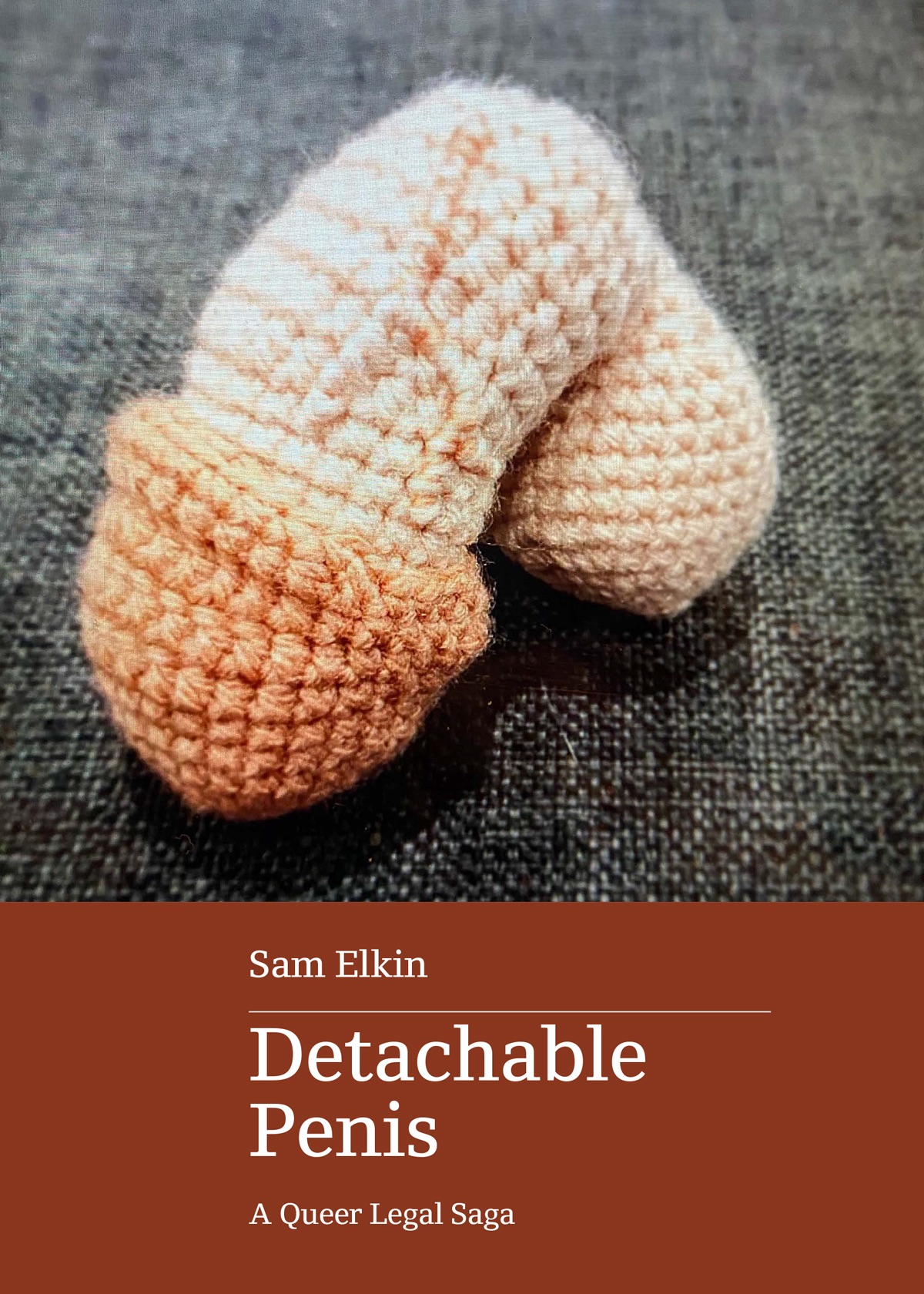
Increasingly I think the border between the personal and the professional — like most borders — is an arbitrary one. We spend so much time wringing our hands over what is and isn’t appropriate on either side of the line that we forget to wonder: who put the border there? Who is benefitting from it? And why does it seem to shift all the time like a writhing snake? These are more difficult questions with much more interesting answers.
They are also questions that are particularly pertinent for people on the margins. In this memoir of work and life, Sam Elkin interrogates “the border between personal and professional identities” that makes up “the rainbow industrial complex”. When he is asked to participate in so many queer and trans panels, interviews, consultations, focus groups, and international days, all the ad hoc demands of the minority in the workplace, is he being asked to draw on lived or professional experience? And why are so many of these things, which take up so much time and seem to be foregone conclusions, unpaid? After one such interview, he feels “strangely used and exploited, like a gunky tissue”. At another, he feels “sad, confused and vaguely complicit”: “I was sure that we’d all been duped, paid off in ancient grain salads and mini muffins”. On Trans Day of Visibility, he writes:
There was my daily waking life, where I worked and gave interviews about the importance of trans pride. Then there was my night-time waking life, where I obsessed over my dickless body and the likelihood of me ever being able to afford genital surgery.
In other words, this is a border obsessed with sanding down the messy reality of existence. Detachable Penis restores that messiness. It begins in 2018 in Melbourne, with a rare flush of guilt money flowing to queer community services after the toll of the marriage equality plebiscite the year before. Elkin, a community lawyer, has been tasked with setting up the first queer legal service on the smell of an oily rag. On his first day his burnt-out colleagues try to find him a functioning computer and a space to work. There’s a server kept in the toilet because it’s the coolest place in the rundown community centre. The caseload would make a corporate lawyer melt into a puddle.
The centre is also a kind of refuge. It offers a space Elkin can transition, away from the eyes of his wider professional community. He begins testosterone the same week he starts his job. Top surgery, changing identity documents, and penis contemplation follow in an exacting portrayal of the hurdles trans folk face in realising their identities. Before top surgery, Elkin has to show he’s been psychologically assessed for “gender dysphoria”: “I needed a letter from one man to tell another man that he was free to charge me $10,000 to remove my breasts”.
But there is also plenty of gender euphoria and gender humour. On using the men’s toilets at an AFL game, Elkin writes:
Rows of dudes stood pissing at the urinals, reminding me of footage of industrial-scale farms where hundreds of cows were simultaneously milked by gleaming steel machines.
Later, he wonders at the barbershop with and its accoutrements of leather, wood and lumberjack odours, “it was funny. This was a place where men groomed each other, so they had to butch it up to compensate”. It’s a joy to read masculinity through this prism; so rarely is it subjected to this scrutiny.
This is a compelling and painful record of the years following marriage equality in Australia. Despite the endless corporate invitations and incremental changes to improve trans people’s lives, this was a time when transphobia began to rise again (as it continues to do), fuelled by right-wing populists and joined by trans-exclusionary feminists and neo-Nazis. Detachable Penis is most potent when it addresses this jarring coexistence of corporate diversity and inclusion on the one hand, and hate on the other. “The current discussions about identity were steeped in the neoliberal individualism of our age, marked by a conception of the world that I found deeply anti-collective,” Elkin writes. He shows there may be no real boundary between the personal and professional after all.
Gay rating: 5/5 for trans and queer memoir, relationships and themes.
Discover more from The Library Is Open
Subscribe to get the latest posts sent to your email.
 The Library Is Open