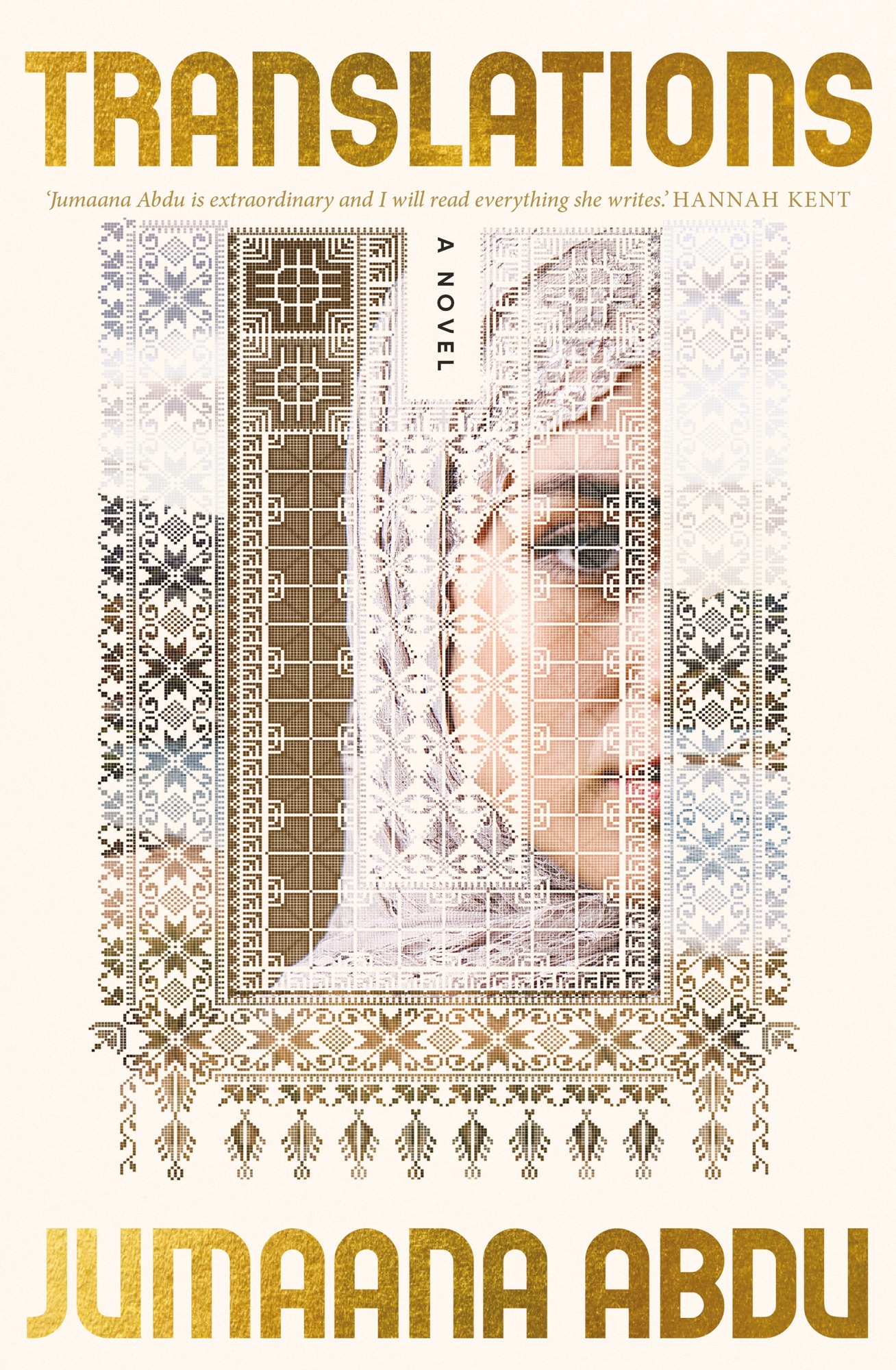
A much stranger book than it first appears, Translations begins with mother Aliyah and nine-year-old daughter Sakina in flight. They have become “uncitizens”; “they would be the only two people they needed to survive”. Their flight and statelessness though is not from a nation but from the city and a marriage following a series of disasters. They move to regional Australia where Aliyah has found refuge in a three-acre property. She keeps herself busy by restoring its gardens, with the assistance of Shep, a Palestinian man who left Gaza in 2009 and also serves as the region’s imam. Shep is almost agonisingly contained, “a soul without a body”, and Aliyah is equally drawn to him and infuriated by him. Shep is a stark contrast to Hana, Aliyah’s teenage soul sister, who becomes fervidly entangled once more in Aliyah’s life alongside Hana’s troubled brother Hashim.
Drama ensues — a rescue from a flooded river, a bushfire and dust storm, numerous heightened confrontations as the characters struggle to express their desires. But Translations is not only well-crafted melodrama. Most of the disasters are unspecified, and certainly not shown in detail, so they take on a densely allusive quality. This is an examination of violence — state, domestic, the systemic violence of racism, Islamophobia and patriarchy — and its consequences. “Any violence in this country is one of two types,” Abdu writes, “Behind closed doors, or swept under the rug of the white man’s history”. Israel’s violence to Palestine is mentioned in passing, yet it seeps through every page, in the weight of what is unsaid, body language, dreams, silent looks between characters.
“They spoke in riddles so as to avoid saying anything,” Abdu writes, and like her characters, her prose labours away at the things that separate people from each other, scratching towards common ground:
the most essential and rewarding labour in life, the work of coming to another human being though you may have the abyss of your whole lives between you.
Translations meditates on what we owe to one another when relations are not structured by imperialism. So many things unspoken, including the novel’s latent queerness, at least as it is defined in the West. Characters blur gender boundaries; Aliyah prefers masculine clothes and wears her hair short, while Shep prefers his long. There is absolutely no explicit sex in Translations, but what else are we to make of lines such as “they let the asymptote of distance approach zero, relieving themselves in many a malleable sigh”? It is the height of Translation’s allusive power, and much as I was awaiting the novel’s Challengers moment, I will admit that that would be a very different vibe.
Dense and riddling as it may be, Abdu’s prose pays religious attention to the moods of the land, such as when Shep joins Aliyah for morning coffee on the porch:
They looked out upon the luminescent navy scene. Minutes passed. Finally, an amber sprite appeared over the dense canopy. The hemispheric dial turned and spilled its light little by little over the land, over the chloroplast of broad bean leaves, the winking pond, the rosella flitting from a red gum to the clementine tuft of a silky oak tree … they harmonised themselves with the hibernating cicadas and the scuttling ants and the small black Australian bees. The day unfurled like an orchid. They were clutched in the embrace of silence at its peak.
The work of tending the land, of tending each other — Translations conceives of these as labours of devotion.
Gay rating: 3/5 for suggested queer characters and relationships.
Discover more from The Library Is Open
Subscribe to get the latest posts sent to your email.
 The Library Is Open