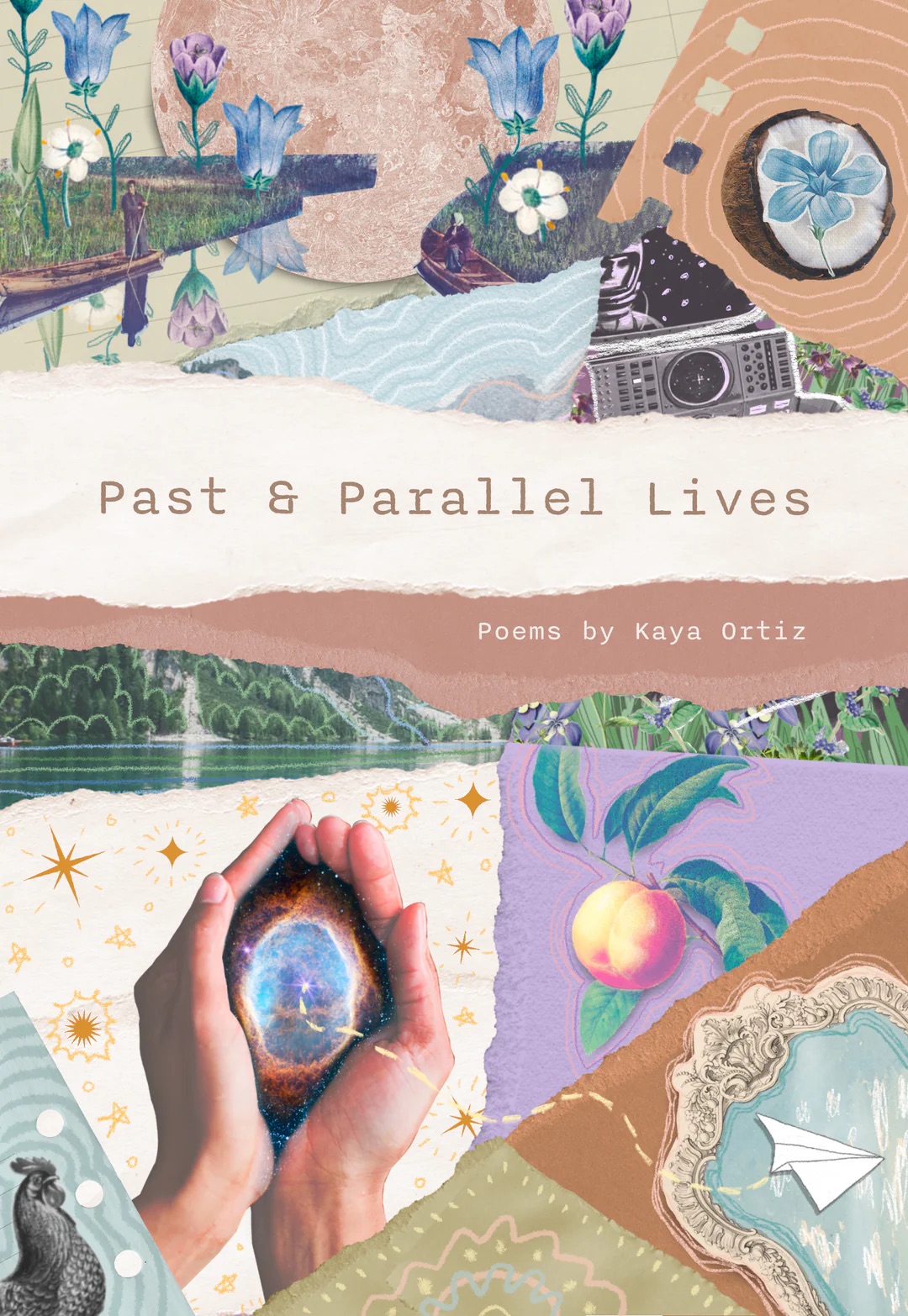
This collection begins with the poet on a departing flight from the Philippines, leaving a home: “lock its heavy air in your lungs.”. They are also leaving love, “the queer ache in her absence”. “Who will I be without?” they wonder. In the next poem, Migration Story, an early highlight, “the plane never lands”, “my skin, stuck in time”:
i exist everywhere […]
in my eternal departure
These two poems ably set up the themes and questions that Kaya Ortiz investigates over their collection. Symbols recur as signposts — the river of the poet’s ancestors, the tongue that has fallen heavy and silent in their mouth, the ocean that dissolves, borders and connects. There are many riffs on Star Trek, odes to bending space and time, and to queer longing. Ortiz describes writing slash fic about two of the series’ female-alien leads:
learn how to pleasure another woman
in some far-off impossible
future
The collection has a pearlescent, Tumblr-shimmer, digital notes-in-bottles sent out into the universe searching for that one reader, the only one who matters. These poems search for belonging — in gender, sexuality, language, history, land — yet find the identities available to them limiting or compromised (in Mask):
i try on labels / see what fits / gay / straight /
bisexual / girl / boy / other / i name the line between knowing /
and denial / i call it / home
In the polyphony of the Philippines, they find their private school English coarse, the “forbidden vernacular” of the land “knife-sharp” against their “twisted tongue” (Bisdak). This dislocation is a legacy of colonialism and globalisation. “Shores shift into borders,” they write in Memoir of these impositions; later in Un/compassed, arranged on the page in cardinal points:
the lines they draw around you re-
write history / to uncolonise your
body call yourself whole
Perhaps the collection’s clearest mission statement arrives in Tasseography, the subtitles of which are Filipino loan words from Spanish, Hokkien and Bahasa:
Mahal.
The tragedy: I [ left / lost ] before I am [ found / fluent /
fed / falsified ]. The cost of migration is my body, multiplied.
Amputation makes everything a phantom. In the dregs I make
and remake it:
Dissolving, travelling through wormholes and time jumps, Ortiz travels space-time through dreams and memories. They conceive of air travel as a rupture:
window seat / fading lights
the black ocean beneath
the emptying night
then / nothing
Then in Roots, the collection’s apotheosis, time and languages waver and blur into each other, beginning with a photo of their apu “peeling silver dissolves/into sepia tone photographs” (translations are provided in a glossary):
every alas-dos sa hapon, umuulan
na naman — du-pi, du-pi, du-pi.
the wet earth is my mother tongue
I open my mouth to taste it. tatay
breaks the neck of a manok. I listen to
him speak but I do not know the words.
Later we learn du-pi is the sound of rain drops, and their grandmother’s pet name for the poet. The yearning for home, for the words that feel right, pervades this collection.
Gay rating: 3/5 for queer subjects and themes.
Discover more from The Library Is Open
Subscribe to get the latest posts sent to your email.
 The Library Is Open