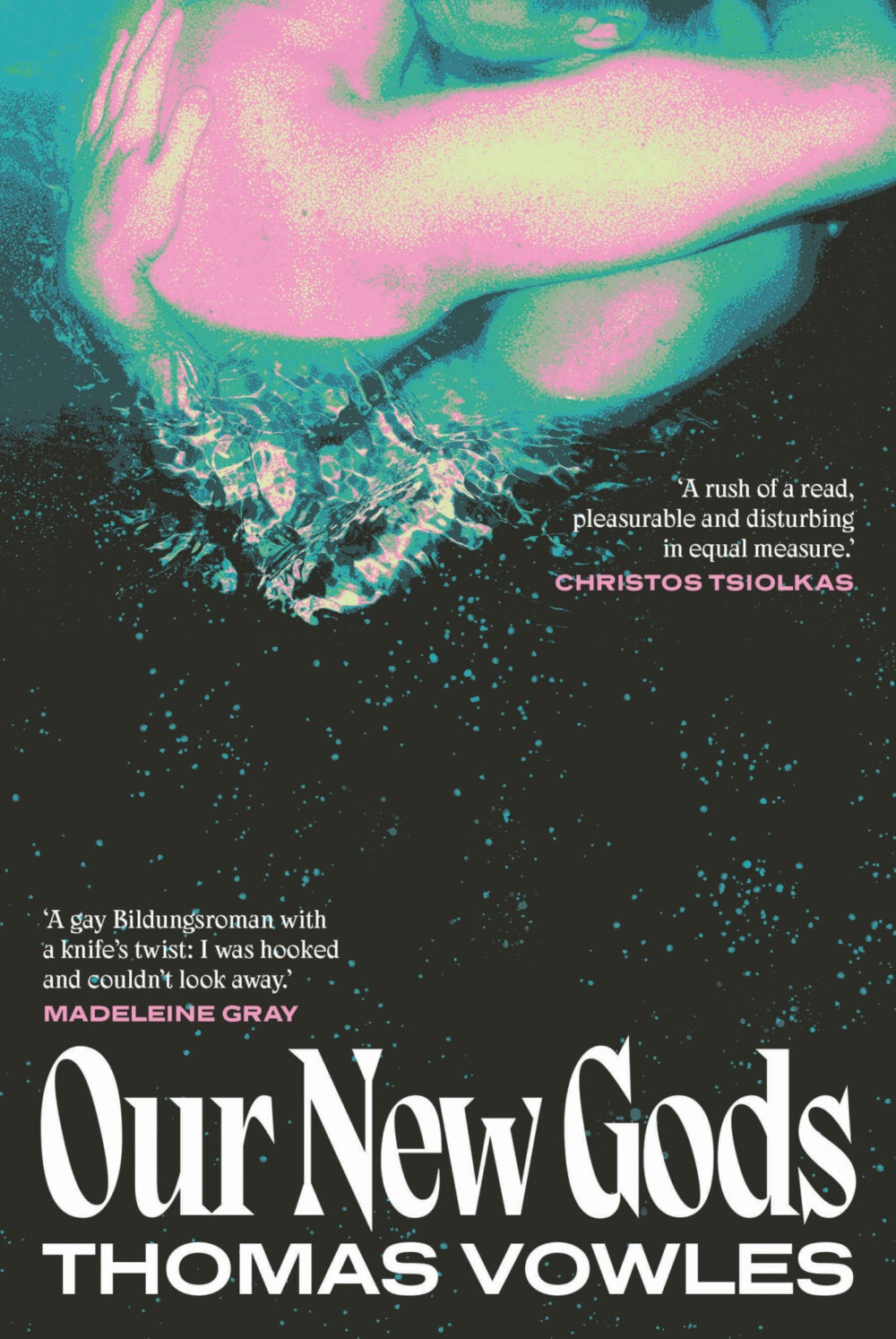
Menace prowls the streets of Melbourne’s inner north in this rather naughty and impressively strange novel. Our New Gods begins, as so much early-20s life does, with a house party. Attending is 21-year-old Aries, Ash, recently arrived from smalltown Western Australia, invited by James, with whom he had a failed dalliance that became a friendship, although Ash’s feelings still seem to run deep. Beautiful, privileged, propertied James (“I think we’re ready for aliens … like, psychologically”) is unfortunately now seeing Raf, a Brazilian DJ who looks like “Jesus in an old oil painting” (like, perhaps, a Raphael?). “I dared not wonder what Raf had that I didn’t,” Ash wonders pathetically. But then he witnesses Raf, a Leo, doing something despicable to a Piscean in the gutter outside the house. Was this a consensual act of submission and domination, or something more ominous? When said Piscean later turns up dead in a lake, Ash begins to put things together.
Deliciously, Ash quickly takes things way too far, as he pursues his investigation (loosely defined) through parties, saunas, sharehouses; the haunts of gay Melbourne. It is entertaining to watch Ash’s rather active imagination seize control, with violent consequences for all involved. There could be some sort of parable here about misinformation and assumption, but fortunately Vowles doesn’t dwell too much on morality. What emerges is a queasy game of the power we hold over others, and how that power is passed on like a contagion. Ash and James and their relationship are an uneasy portrait of youthful confidence and insecurity, and how both can be exploited — they are gods of their own lives. In a few piercing moments, it is also a reminder of their aching vulnerability.
There’s something else lurking in the pages of Our New Gods: holes that might be portals, insistent yet mysterious noises, allusions to myths ancient and new. Ash wonders at Melbourne’s “creation myth”: “dreamt days fully of whimsical encounters with strangers, in a new land where gorgeous furniture lined the streets.” He may see meaning everywhere, especially where there is none, but he is also alienated from it, watching from the dark streets the life inside lit-up homes:
Everything was a clue to be decoded: here, a red door; there, sunflowers swaying eerily in the night. Someone had left a light on in their front room — I crossed the road, drawn by the light. How could there be a life in this house, a whole life, and here was mine? … Ultimate meaning was hidden, but only just out of reach, behind the delicate scrim that separated me from everything.
If at first this allusiveness feels strained, it eventually becomes grounded in the experience of being young and freed from family and home. In rendering Melbourne queer and uncanny, Vowles builds on the novels of Ronnie Scott, but with an extra bite. The provocations are well-earned.
Gay rating: 5/5 for queer characters, relationships and explicit sex, including some truly boundary-pushing scenes.
Discover more from The Library Is Open
Subscribe to get the latest posts sent to your email.
 The Library Is Open
1 Comment