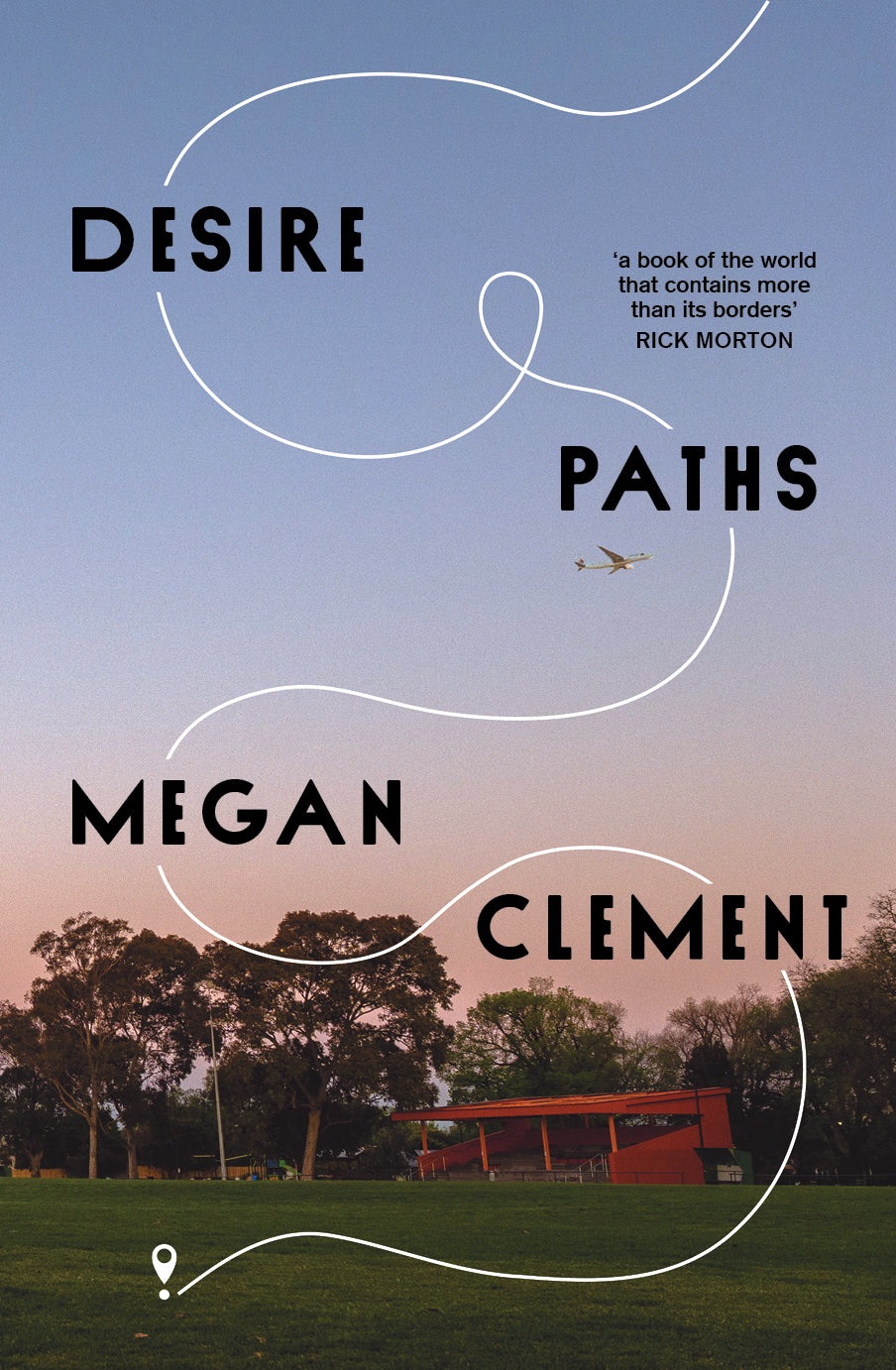
We talk a lot about American exceptionalism, but Australia does it too, and perhaps worse, because it comes hidden behind a larrikin grin. Australian exceptionalism is a fiction, of course, but a powerful one. When combined with the powerful fiction of white exceptionalism — supremacy — we end up with scenes like the ones that saw Nazis gather once more on city streets under the Southern Cross and Union Jack in protest at “immigration”, while also attacking Camp Sovereignty, a long-standing protest site for the original owners of the land. In other words, incoherence, but violent and frightening incoherence.
Journalist Megan Clement explores these exceptionalisms and contradictions in personal detail in this gripping and deeply felt memoir. White, English, possessed of desirable passports, Clement was able to pass relatively freely between the nations of the West, until 2020, when she found herself on the wrong side of Fortress Australia as she tried to get back into the country to be with her dying father. It feels personal. Despite having lived in Australia for over a decade after her family migrated from the UK in 2000, Clement finds her status precarious. “Migrants especially,” Clement writes of Australia, “are expected to be grateful … to leave it again is considered an insult.”
We join Clement first in March 2020, as she socially distances in an Airbnb across the park from her parents in inner northern Melbourne. Pursued by the virus, she has travelled around the world from her home in Paris via a reporting fellowship in Mexico that was cut short by border closures. “Every journey had begun to feel like a referendum on the choices I had made,” she writes. She returns to Paris, before getting the call in June 2020 that her father is dying, and crosses the oceans once more. What follows is a harrowing two weeks in hotel quarantine at Melbourne Airport. Clement spends her days “fighting bureaucrats” for compassionate visits to her family, “lying in a morning sunbeam”, documenting the violations of public health and human rights in the hotel corridors, and going mad. It’s terrifying but also absurd, and Clement conjures both with laser-like attention to her surroundings and her own thoughts (“Dinner arrives at the unconscionably early hour of 5:30pm (don’t these people know I live in Paris?)” she rails amusingly at one point). “The zeal with which the nation took to [hotel quarantine] reveals something about its undergirding ideas about its place in the world,” Clement writes, “A nation not afflicted by the tyranny of distance but sinking into the luxury of it”.
Australia is not exceptional, except when it is, and the real exceptions reveal “the undergirding ideas about its place in the world”. In the pandemic, it was the complete closure of the border to India, or the hard lockdown of public housing towers, effectively turning them into prisons, which, Clement writes, “sends me over the edge”, a feeling I remember only too well. Looming over it all is the horrifyingly-named Pacific Solution, which sees anyone arriving in Australia by boat detained indefinitely on offshore islands, “a Frankenstein’s monster of an idea that lurched out of Australia and into the psyche of other island nations” (a sentiment that also popped up absurdly during the pandemic, as newspapers in Tasmania proclaimed on their front pages, “We have a moat, and we’re not afraid to use it”).
Let’s not forget that, just before the race riots on August 31, Australia’s Prime Minister quietly announced a deal to remove non-citizens to island detention, an expansion of a scheme once designed only for those arriving by boat. Australian politicians, Clement writes, have been careful to construct a moral cover of “‘saving lives at sea’ … which allows a policy of institutionalised torture to become bipartisan and therefore permanent”. There is no reason to expect this won’t continue, or indeed get worse as the climate crisis deepens. One of the things that keeps me up at night is the strong possibility that Australia will approach the increasing number of people displaced by climate change with the same carceral response.
The antidote may not just be mythbusting the impacts of migration on Australian lifestyle, but a defence of movement itself. Clement mounts such a defence in her tracing of the “desire paths” that have taken herself and her family across continents and decades, from Zimbabwe to the UK to Australia to Paris. Citing Edward Said, Clement conceives of migration as a bittersweet ordeal, one that offers “the audacity of daring”, but also comes with an inherent sadness, especially if not by choice. In Desire Paths Clement traces these lines of feeling: the love, nostalgia and fond memories of places and times left behind, the hope of new ways of living, the agony of separation, the rage against borders, the “infinite possibilities”:
to walk around a place, knowing no one, feeling bewildered by difference … is to begin to forge a new version of yourself.
Clement’s experience as a white migrant in Australia is exceptional, but it shouldn’t be, “the universalism and inherent banality that should constitute the very ordinary, if life-altering, act of moving from one place to another”. Movement is one of the three fundamental freedoms identified by David Graeber and David Wengrow that have been suppressed by modern states. Amitav Ghosh and Sally Hayden have considered the role migration plays in addressing colonial injustice and climate crisis. Geetanjali Shree dreams of a border that doesn’t divide but blossoms, “it opens out”. Such a world feels remote, but worth fighting for.
Gay rating: not gay.
Discover more from The Library Is Open
Subscribe to get the latest posts sent to your email.
 The Library Is Open
1 Comment