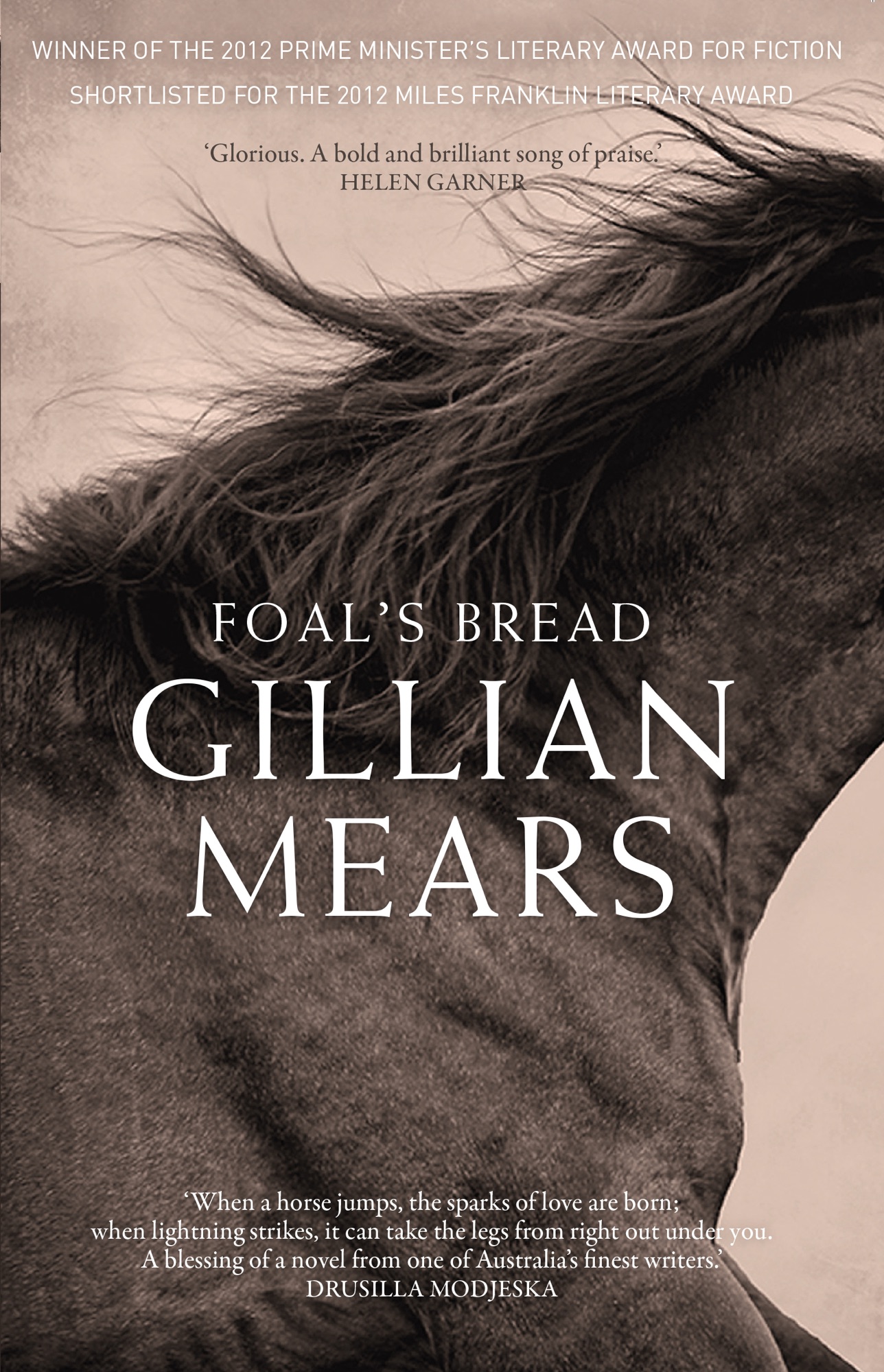
It’s 1926 in New South Wales’ northern rivers region, and 14-year-old Noah Childs, a girl with “the jumping dream”, comes upon One Tree, the property of the Nancarrow family. She’s to become attached to the property in ways harrowing and hopeful. Riding up the hill, she dislodges the pregnancy she’s carrying by her uncle. “Knowing and not knowing” what she needs to do, she puts the baby in a butter box and sends it down the river. At a show jumping competition in the fictional town of Wirri shortly after she meets the Nancarrow son, Rowley. They connect immediately over their passion for jumping, and aspirations to build a team of champions. They wed when Noah is 20, and start building their life on One Tree.
In Foal’s Bread Gillian Mears expertly charts the soaring highs and lows of life’s vicissitudes both personal and historic, conjuring a lost world. Noah’s tie to One Tree can sometimes feel like a blessing, sometimes a curse. The heavy hand of fate is always lurking, and it will strike again and again in this novel. Mears expertly evokes the life of the land in all its weather and variation. This is land that speaks in human tongue, where the seasons cry “these are the golden days, this is the golden-year, hurry-hurry-hurry”, where “through the stirrup irons might come the voices of the dead”. She is anthropologically observant of vernacular and how the people of the land are attuned to mysterious ways that happenings are not quite coincidental.
Violence roils underneath the surface. Noah’s mistreatment by her mother-in-law from the get-go is racially motivated; Noah’s grandmother was First Nations. Her abuse at the hands of her uncle threatens to repeat in another generation. Animal, human, land are all animated by the same fickle flightiness and subterranean currents. A horse is an extension of a woman, “the power in her belly like a cord which carried the horse forward”. Mears writes wonderfully of the partnership between human and animal, how “the horse agreed to jump”, and the allure of “the power underneath” in jumping. “What are ya?” the riders ask when soothing a horse; it could equally be the question motivating Foal’s Bread’s study of people. Jumping is a form of transcendence, of straining for the heavens. Foal’s Bread accounts for the burden and costs of the attempt.
Gay rating: not gay.
Discover more from The Library Is Open
Subscribe to get the latest posts sent to your email.
 The Library Is Open