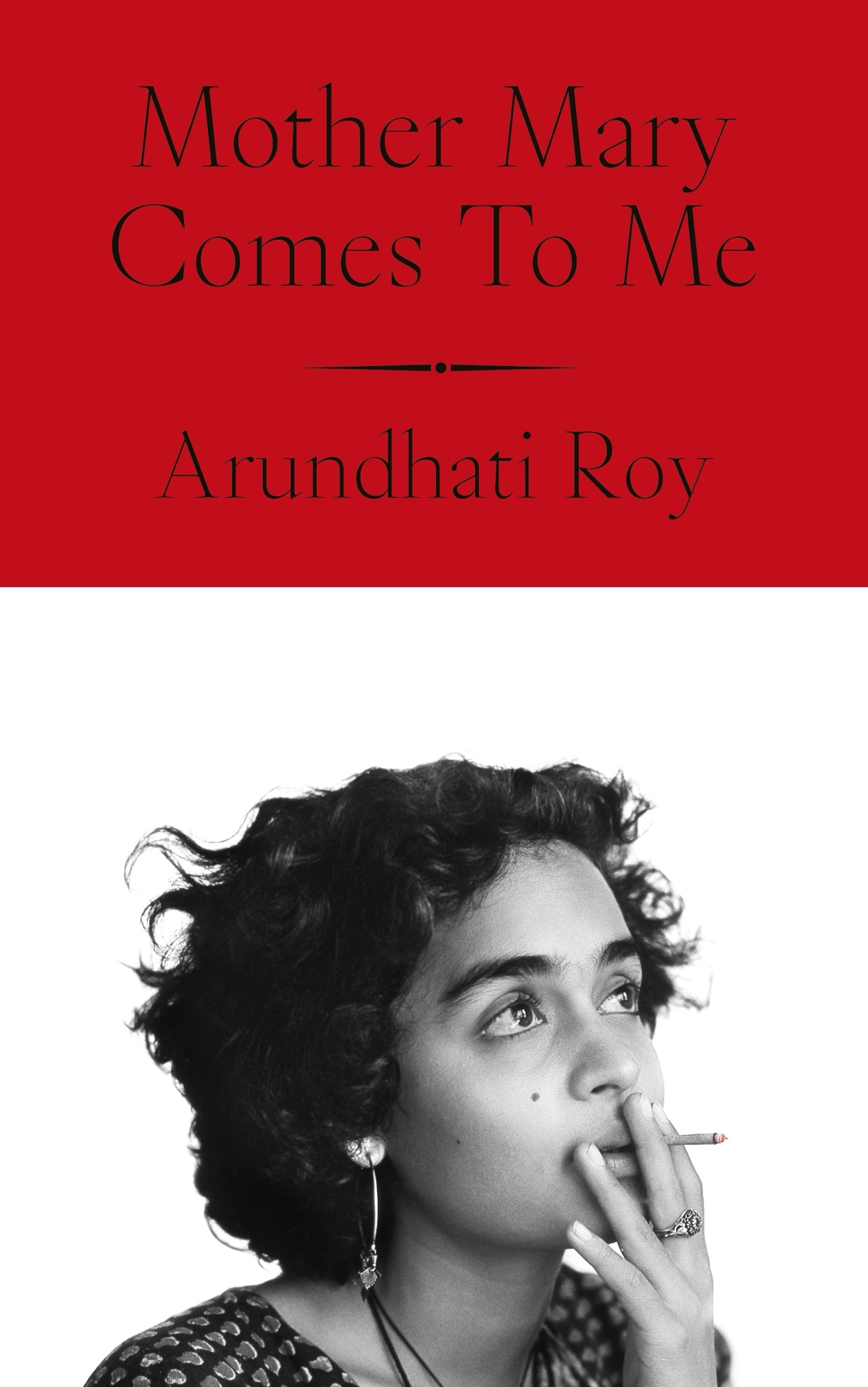
Midway through The Ministry Of Utmost Happiness, Arundhati Roy’s second novel published in 2017, the story takes a hard turn as the setting shifts to Kashmir. Roy writes of the surveillance and violence of living under occupation. It feels different, like reportage, as Roy documents atrocities committed by Indian security forces. In Mother Mary Comes To Me, her first memoir, she writes that the novel “evolved as a conversation between two graveyards”, the one in Delhi which frames the narrative, and Kashmir. Roy has been ringing the alarm about the rise of Hindu nationalism for a while now and at increasing cost — open calls in the media for her execution, a series of legal battles — a cost she documents with understated humour in her memoir.
Born in 1960, Roy was raised in a life of precarious privilege. Her mother Mary forewent her family’s generational wealth when she divorced her husband. Settling in Kerala, in 1967 Mary founded a progressive school that insisted on girls’ education. Later she had a campus built, designed by vernacular architect Laurie Baker. Inspired, Roy went to Delhi to study architecture. Later she became first a film writer and then an essayist, before publishing her first juggernaut of a novel, The God Of Small Things. Although it often seems like Roy’s ideas and ethics were born fully formed as a precocious child (when she learned of a Maoist attack at age nine she writes that “I understood their rage instinctively”), it is enlightening to trace the expression of them and the people who influenced her — friends, lovers, activists, the people of the street in Delhi.
Roy’s memoir is primarily a reckoning with her relationship with her mother after she died in 2022. Describing her mother as a “gangster”, Roy documents the torment and abuse Mary inflicted on Roy and her brother and the people around her. Sometimes physically violent, often verbally, Mary was an authoritarian narcissist, treating her children with contempt. Suffering from lifelong asthma Roy writes that “she recognised quickly that ill-health was a good way of controlling people … I became her lungs”. On a trip to scope out Baker’s architecture, Mary berated a teenage Roy for making her look like an idiot, and left her beside the highway for hours. Mary “made it her mission to disabuse boys of their seemingly God-given sense of entitlement,” a not unworthy mission but one executed cruelly within the home; she started calling Roy’s younger brother a “chauvinist pig” when he was six. Although Roy does not make the connection explicitly, and writes with grace from a place of love, awe and heartbreak, it is perhaps no mystery why she was drawn to write against domination. Her mother’s “gift of darkness … turned out to be a route to freedom”, Roy writes.
Roy writes scintillatingly of becoming a novelist, of hunting down her writing voice, which she describes as her “language-animal”. But the astonishing success of The God Of Small Things was complicated for her. “I still hadn’t lost that very real, very tangible feeling,” Roy writes, reflecting on her childhood, “That each time I was applauded, someone else, someone quiet, was being beaten in another room”. The novel, and its critique of caste, was “depoliticised” in India, “It began to be spoken of as a book about children, praised for its lyrical language and stripped of its politics”. Faced with this “gilded cage”, Roy shared her royalties, and used her status to offer strident critiques of rising Hindu nationalism, nuclear testing, the Sardar Sarovar dam, and the military occupation of Kashmir. “If I said nothing,” Roy writes, “It would automatically be taken to mean that I agreed with what was going on”. Visiting Kashmir as an Indian citizen “who has even a sliver of conscience,” she writes, “is to be un-homed … there is no innocence”, which is an equally apt description of the West’s participation in the Palestinian genocide. Roy’s memoir is a powerful argument for spending privilege to disrupt oppression, and an example of how to do so usefully.
Gay rating: 2/5 for brief discussions of queer themes.
Discover more from The Library Is Open
Subscribe to get the latest posts sent to your email.
 The Library Is Open