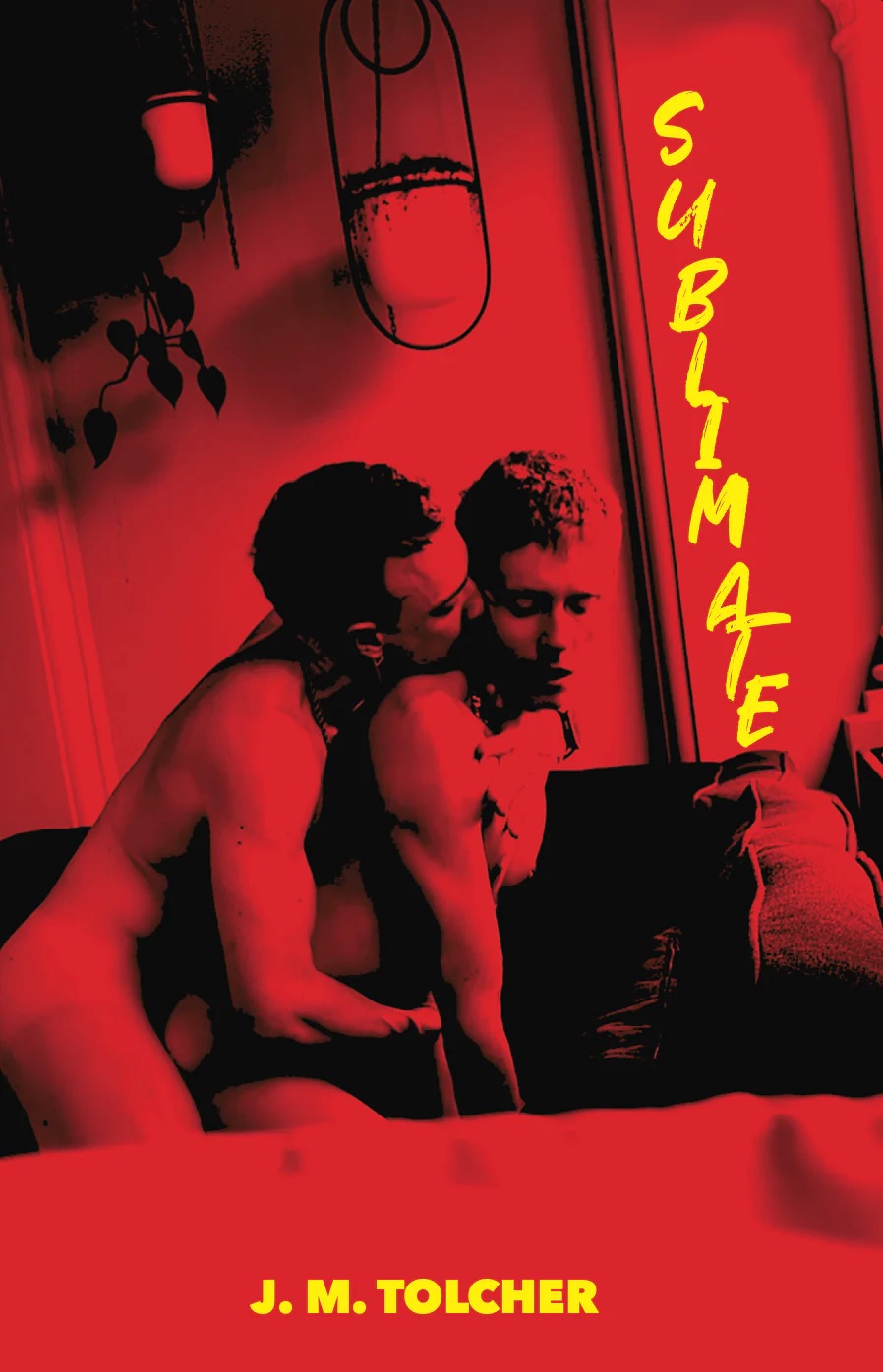
To sublimate is to transform. For the alchemists, it described the transformation of generic metals into gold. Chemically-speaking, it still means for a solid substance to become a gas without first becoming a liquid — surely a miracle of sorts. Psychologically, as J M Tolcher reminds us at the beginning of this short novel, sublimation was the transformation of apparently destructive impulses into creative ones. Freud thought these impulses to be transformed (through redirection) were libidinous; later psychologists like Jung diagnosed repression itself as the problem, including the impulse to repress desire itself, or even the desire for masochism. What a tangle!
Tolcher has a little of all of the above. He gives us a substance to be transformed, and a process to do so, and so, we should be able to measure the outcome. The substance to be transformed is … cum. Quoting the French novelist Balzac who wrote, after cumming, “there goes another novel”, Tolcher diagnoses the destructive impulse as the spent post-ejaculatory haze. As the author/narrator of Sublimate he writes “under certain ejaculatory conditions” ie not cumming while he writes, a condition that also has intriguing resonances with the most ancient of heterosexual shibboleths to not spill one’s seed unless for creation.
But Tolcher doubles and then doubles down again. Sublimate unfolds in two narrative strands. The first is diaristic, titled simply for the number of days that have passed without its writer ejaculating (although fiendishly we do not find out the final number). The second, interwoven, mirrors the stages of transformation through the old alchemy — albedo, citrinitas, rubedo. These are told in second person, opening up the possibility of the existence of an ‘I’ within the narrative as well (the narrator to the reader and the world? The narrator’s ego or superego to their id? Tolcher lets the ambiguity foment). These recount a 30-something man and his exploits in love in 2024. Boy are they exploits! From chat rooms with maybe-Nazis to saunas with maybe-paederasts, near misses with a meth gang bang (“you have no doubt it would feel so amazing that you would be dead in a couple of weeks”), all manner of bondage, bloodplay, humiliation and degradation, Sublimate, incredibly, makes Guillaume Dustan or Adam Mars-Jones look like child’s fairytales, enlivened by the entertaining lengths the narrator goes not to cum despite engaging in said exploits. These passages, which I just can’t quote directly, have a poetic brilliance, beautiful and strange, hot and grotesque. Full marks, if this is the measure of the sublimation Tolcher seeks.
Tolcher’s narrator wonders aloud what drives him to desire this degradation “like my sexuality is a puzzle I can solve with my mind”. He dismisses an Oedipal complex (“you craved some paternal guidance where there was none”), remembers abusive lovers. “You sought knowledge,” Tolcher writes, from older men, “considering there was absolutely nothing in the education system to teach you about yourself or your sexuality”. The psychologist Erich Fromm wrote that “repressed masochism … gives rise to fascism”. This is the ultimate act of sublimation Tolcher’s narrator seeks, to transform through submission authoritarianism, “the plague we fight”:
Sublimation and liberation must happen through you. Your fire was a gift. And to give that gift to others, to spread that fire like justice, you must live authentically.
Who knows if Tolcher is on the money — the path from theory to practise never runs smoothe — but Sublimate is ecstatic depiction of the effort and the process.
Gay rating: 5/5, obviously
Discover more from The Library Is Open
Subscribe to get the latest posts sent to your email.
 The Library Is Open