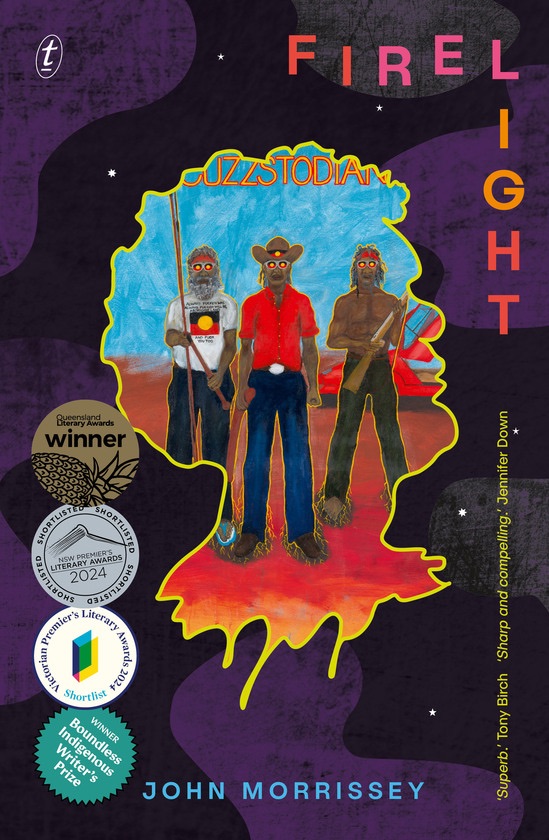
This unnerving collection opens with Five Minutes, previously included in Mykaela Saunders’ anthology of Indigenous speculative fiction, This All Come Back Now. The story is a highlight here, half grim bureaucratic satire of young public servant Mikey tasked with collecting Koori folktales, half alien apocalypse story-within-a-story written by the same bureaucrat (an amusing fuck you to the quaint expectations of his employers). It’s a brilliant premise explored in purposeful prose, but Morrissey conjures something terribly sad from the “vague yearning” Mikey experiences on summer evenings:
for the past or for the future, I cannot say. When I was eighteen, twenty, this yearning was my chief delight and consolation; now it sticks in me like a fish hook.
“These were healthy people,” Mikey says of the Koori people who produced the stories he is charged with collecting; he writes from “my shameful sickbed in the West”, and the apocalypse arrives more as relief than rapture.
That yearning, a feeling of ill-fit and ill-health, is present in many of the protagonists of this collection, white and black. In Special Economic Zone it is Emma, who receives receives her inheritance from her mineral tycoon father who “was aways standing around in the desert with groups of Aboriginals”. In Ivy, it is the young man returned to live with his mother while his friend Tom attempts to recruit him into a white supremacist organisation. In Gothic tale The Last Penny Amy searches for closure after the death of her convicted child abuser brother, while wondering at his religious faith. Autoc, a brilliant almost-novella, follows another pair of siblings, Shahida and Gabriel, on an alternate or future Earth, or Earth-like planet, that has been colonised once and is under threat of colonisation again from aggressors on its moon. The Autocs of the title are the now near-mythical original people of the planet. Like The Last Penny, Shahida ponders her brother’s faith, hope and convictions that she is unable to fully embrace. The collection hangs on this tension between pragmatism and transcendence. Its yearning is material, often generated by the rupture of colonisation, and the violence produced by it.
The premises are exceptional. Morrissey gives the resurrection of extinct species trope a wondrous twist in The Rupture. The unnerving Tommy Norli is historical Gothic, a ghost story set on frontier inland Australia forty-odd years after the first white explorers passed through. These stories are also wonderfully open-ended, resisting explanation and resolution, and their discomfort lingers. Saunders writes in the introduction to This All Come Back Now of the ill-fit of the Western idea of speculative fiction when applied to Indigenous writing because the genre “employs devices that our cultural stories have dealt in for millennia”. Morrissey’s collection crosses genre boundaries with ease, breathing urgent energy into the tropes of these genres.
Gay rating: not gay.
Discover more from The Library Is Open
Subscribe to get the latest posts sent to your email.
 The Library Is Open