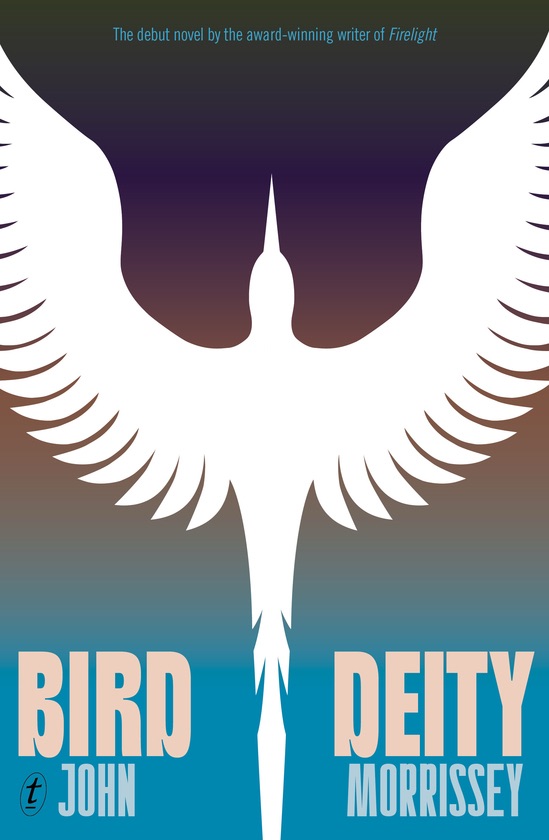
Like the rains and mists that slip through this novel, concealing more than they reveal, Bird Deity opens on unstable ground. Eliza, a botanist, and David, a Scout considering extending his contract for another five years, meet by a river. Eliza is pregnant; the baby may not be David’s, but it’s clear their relationship is rather more than platonic. Tom, Eliza’s partner, is “up there” somewhere. The narrative skips forward five years as David nears the end of his contract; Eliza has had the baby and is trying to get home; Tom has disappeared. The sun rises in the west. Slowly we learn a little more: we’re not on Earth; David and Tom are Scouts contracted by an Association of Chartered Geographers to explore a plateau inhabited by creatures known as parasapes and take valuable artefacts from them; travel to and from the planet depends on gaining a berth on transport frigates. When anthropologist “Sarah” arrives, looking for a guide to take her to the plateau to study the parasapes, David is required to make a final journey.
Morrissey conjures a dreamy and unsettling atmosphere that is grounded in the physics of the world he has tightly conceived. Events and incident have a weightless quality, as if the gravity of the planet is lower. Details are gleaned rather than expounded: there’s a company with increasing interest in the planet; the Association’s Scouts are excepted from laws that others have to follow, such as being allowed to carry arms and use them; Sarah has been employed by a beneficent philanthropist who wants the parasapes declared a protected species. Dreams and memories, or dream-memories — David’s, the parasapes’ — flit through the novel, suggesting a mythical narrative for the origins of the parasapes. Morrisey infuses description with the atmosphere of the planet, such as David and Sarah’s approach to the plateau:
the wall … was close now. The edifice of blue-black stone was woven across its length with silver threats of falling water. Here and there were black eyes and half-open mouths of cave formations, like parts of faces pressed into the wall by the bored hand of a child. The plateau was vast but somehow ambiguous, and David always had the off sense that it might dissolve like a barrier in a dream, opening the way to the sea that lay behind it.
Bird Deity joins other explorations of interstellar colonialism like Michel Faber’s Book Of Strange New Things, or closer to home the speculative visions of Robbie Arnott’s Rain Heron, but Morrissey’s observations here are pointed. The suggestion that the parasapes have suffered a cultural decline mirrors white supremacist theories about Tasmanian Aboriginal people (although Morrissey also plays with this narrative). Their name itself is a recognition of their not-quite status; and therefore how they can be treated. The Scouts are not passive knowledge-gatherers but an integral part of an extractive economy, and also serve as a paramilitary force like Australia’s colonial police. Sarah’s benevolent mission has a strong whiff of paternalism. Like the fictions of Claire G. Coleman, Bird Deity invites these comparisons to earthly events and lets them linger uncomfortably.
But Morrissey also resists them, as does the planet itself, which has strange and disturbing effects on visitor’s minds. There’s an unknowability in Bird Deity. When they come across a monument, Sarah recognises the role she will play, even if it is a benevolent one:
“We can say, “Look, they have a god. They’re just like us. Just like how we used to be”” … “I’ll frame it properly in my report,” she said. “I’ll make clear that this is pure speculation, based on probably unwarranted parallels with early human societies. People will draw their own conclusions, though.”
Sarah and David are not neutral observers; Bird Deity draws attention to the politics of knowledge and its use and interpretation. The explorers realise that the monument “would not speak … no matter what duress they subjected it to, or how they wheedled and attempted to propitiate its unknown spirit”. Bird Deity evokes the yearning for knowing, but faces its limits.
Gay rating: not gay.
Discover more from The Library Is Open
Subscribe to get the latest posts sent to your email.
 The Library Is Open