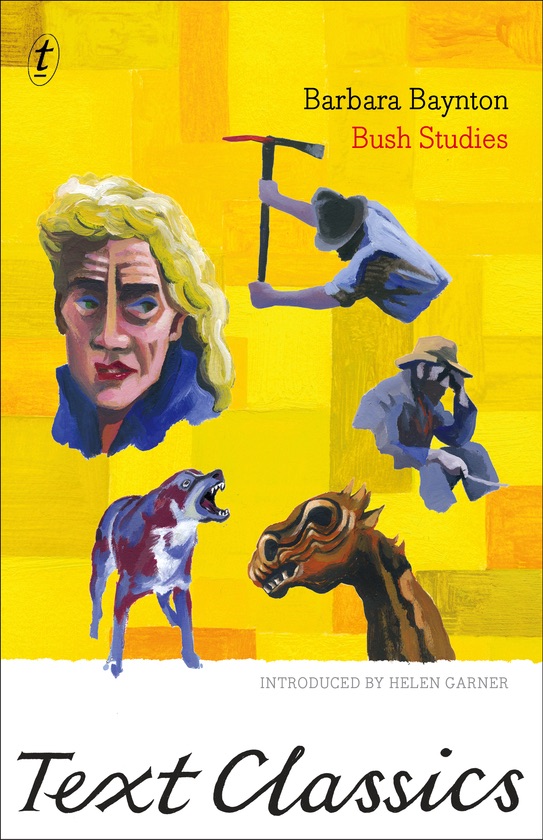
These six stories are set in, as the title suggests, the Australian bush. Where exactly though is unspecified. People come from the city in three of the stories. They are returning after a long absence, as in the woman in A Dreamer which opens the collection. Or they are setting out for new employment, as in the pastor in Bush Church and the housekeeper in Billy Skywonkie. They arrive in the great, undifferentiated bush, eastern Australia surely, but anywhere inland of the Great Divide from Bendigo to Bathurst: anonymous grey-leaved gums with sparse shade fringing desiccated paddocks, dusty bullock tracks, creeks dry or in spate, as in the one that floods during the terrific storm that matches the emotional trial of the woman in A Dreamer. She’s newly pregnant, has alighted in her birthplace at night. In a brilliant moment of ambiguous foreboding she sees a light on in a shop:
the sound of swift tapping came to her. They work late tonight, she thought, and remembering their gruesome task, hesitated, half-minded to ask these night workers, for whom they laboured. Was it someone she had known?
Baynton neither explains the “swift tapping” nor the “gruesome task”, but you will remember both as the story reaches its climax. As she walks the pitch-black night to reach her mother’s house at one point she is overwhelmed, “she fell on her knees, lifted her hand, and turned her face to God. A vivid flash of lightning flamed above her head.”
Baynton plays with these fears of the bush as much as she constructs them, a construction that was part and parcel of the othering of land and people that drove colonisation, the Australian pastoral Evelyn Araluen has taken to task. Baynton’s bush is full of rough, shifty, murderous and abusive men. The woman who is known only as Squeaker’s Mate suffers a disabling accident at the opening of the eponymous story, only to then be horrifically neglected by her partner Squeaker. In Scrammy ‘and the Old Man in his hut is tormented by an intruder set on harm, much like the new mother in The Chosen Vessel, a truly terrifying tale of her vulnerability. Baynton makes much of the gaps between the logs of a bush hut, and what can be seen from inside and outside. “The whole of the night seemed pregnant with eyes,” she writes in Scrammy ‘and; “she saw the shadow darken every crack along the wall,” in The Chosen Vessel. People slip off the mortal coil with unnerving ease and lack of fanfair; conversely, in several of the stories a character not knowing of another’s death drives much of the pathos and irony of the narrative. Baynton revels in the grotesque, dehumanising poverty of her characters, such as the begging alcoholic woman in Billy Skywonkie:
she pointed at her toothless mouth (the mission of which seemed to be to fill its cavernous depths with the age-loosened skin above and below … entrenched behind the absorbed skin-terraces, a stump of purple tongue made efforts at speech).
Although there is some humour too, particularly in Bush Church, in which the sensitive city pastor is confronted by the confounding ways of the bush, particularly Jyne, the powerful Black matriarch and midwife of the family he is attempting to preach to.
Animals have as much character as their humans, like Rosey the recalcitrant horse in Bush Church, “an inveterate yarner”, and particularly the dog in Scrammy ‘and — the tale unfolds as a conversation between the two, the Old Man in the vernacular Baynton renders her characters’ voices, the dog in a cocked head and body language. She evokes the bush intensely, as in Billy Skywonkie:
a sapling studded with broken horse-shoes seemed to connect two lonely crow stone trees. Under their scanty shade groups of dejected fowls stood with beaks agape. Though the buggy wheels almost reached them, they were motionless but for quivering gills. The ground both sides of the shanty was decorated with tightly-pegged kangaroo skins. A dog, apathetically blind and dumb, lay on the veranda, lifeless save for eyelids blinking in antagonism to the besieging flies.
Often, the magic of Baynton’s prose transcends the grim reality reality of her characters’ lives:
The eyes of the sheep reflected the haze-opposed glory of the setting sun. Loyally they stood till a grey quilt swathed them. In their eyes glistened luminous tears materialised from an atmosphere of sighs. The wide plain gauzed into a sea on which the hut floated lonely. through its open door a fire gleamed like the red, steaming mouth of an engine. Beyond the hut a clump of myalls loomed spectral and wraith-like. and round them a gang of crows cawed noisily, irreverent of the great silence.
Gay rating: not gay.
Discover more from The Library Is Open
Subscribe to get the latest posts sent to your email.
 The Library Is Open