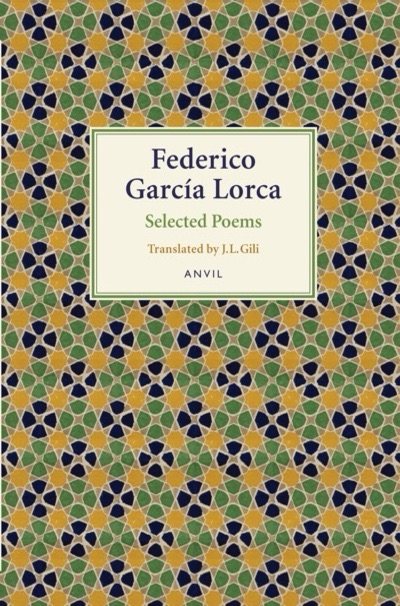
This selection sketches the poetry career of Federico García Lorca. It begins with his first collections, published when he was 23 in 1921. Many of these early poems have the rhythms of songs, some are call-and-response. But even as he would sharpen the forms over the years until his death by murder in 1936 in the early days of the civil war, his thematic preoccupations arrive fully formed. They are poems of Andalusia, its land and its characters. Fountains, clear streams and mountains; groves of olives and oranges; gypsies, bullfighters, knights and widows: Lorca tried and perhaps succeeded as far as anyone could to capture the “spirit of the Earth”, the duende he describes in a lecture included at the end of this selection, “a power and not a behaviour, it is a struggle and not a concept”.
In Cantos Nuevos (New Songs) from his first collection he “thirst[s] for new songs free of moon and lilies, and free of withered armours. A song of tomorrow that will agitate the tranquil waters of the future.” In the following poem Deseo (Wish) he might even find it:
Mi paraiso un campo
sin ruiseñor
ni liras,
con un río discreto
y una fuentecilla.
Sin la espuela del viento
sobre la fronda,
ni la estrella que quiere
ser hoja.
(My paradise is a field without nightingale or lyre, with a discreet river and a small fountain.
Without the spur of the wind over the foliage, without the star wanting to be a leaf.)
Presented by Oxford-residing Catalan publisher J. L. Gili, plain English translations under the original Spanish do their best to unlock some of the numinous mysteries of Lorca’s poetry. As is often the case, sometimes the shortest works are most evocative, like Granada Y 1850:
From my room I hear the fountain.
A vine-tendril and a ray of sunshine. They point at the place of my heart.
Through the August air the clouds drift. And I dream that I do not dream within the fountain.
Death and hijinks are ever-present. In his Romancero Gitano, a series of romances, there are lustful wives and maidens, bandits roaming the countryside and getting into knife fights, lovers scaling towers. These are some of the undoubtable highlights, including the much-loved Romance Sonámbulo, in which the poet begins by professing his desire for the colour green, personified as a young woman dreaming on her balcony. A young, wounded horseman wants to trade all his possessions for her house, her mirror, her blanket, which he confesses to a companion. The two of them climb to the high balconies, “leaving a trail of blood. Leaving a trail of tears”. But the poem doesn’t resolve, rather opens out into moonlight, the taste of herbs, the image of a gypsy girl seeing her reflection in a cistern, “an icicle of moon hold[ing] her above the water”. It is a lush, airy, romantic poem whose mysteries deepen on further reading. The same atmosphere pervades La Monja Gitana, in which a gypsy nun embroiders her dreams, and La Casada Infiel, in which a gypsy ravishes a married woman by the river.
The only time Lorca’s poetry steps outside of Andalusia is in his Poeta en Nueva York published in 1929-30. These are hard, metallic and surreal poems — he was clearly unimpressed by the avarice, industrialism and inequality he found in Manhattan. “There is no anguish to compare with your oppressed reds,” he writes, seeming to sympathise with the marginalised Black community. Later he describes dawn in the city as a “mire”, the water “putrescent”. “No morning or hope is possible there”, he writes, “America drowns itself in a flood of machines and tears”.
It was also here that he writes to Walt Whitman, imagining the poet as an old man, his “beard full of butterflies” and “thighs of virginal Apollo”. He “dreamed of being a river and sleeping like a river with that comrade”. Lorca was gay, but his illicit desire is difficult to parse in his poetry. Perhaps you can sense it in the lustful gaze he puts on the machismo of his horsemen and bullfighters. Perhaps it is in the yearning of his maidens. It is most clear in this Whitman poem, but he clearly had a difficult relationship with his sexuality. Just as he idolises the queer elder, he seems to denounce the “pansies of the cities, with swollen flesh and unclean mind, dregs of mud, harpies, sleepless enemies of Love” (later in the poem he lists various pejoratives for queers from the Hispanic world). He leaves an impression of intimacy and passion that is nevertheless fleeting and hard to pin down.
Gay rating: 3/5 for some queer themes.
Discover more from The Library Is Open
Subscribe to get the latest posts sent to your email.
 The Library Is Open