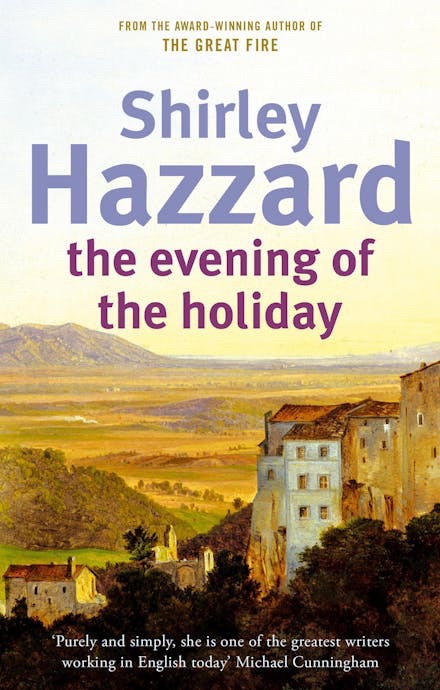
Somewhere in northern Italy, young half-English woman Sophie meets the older Italian man Tancredi. It’s summer and Sophie is visiting her aunt Luisa; Tancredi is staying with his sister, away from the wife he is separated from. As the summer unfolds so does their romance. At their initial meeting there is a very old fountain in the garden. “Has it always been here?” Sophie asks. “She seemed to refer to the beginning of the world”, Tancredi thinks.
Hazzard’s account of this affair, published in 1965 in the New Yorker, is slight in volume, but resounds like the tolling of the ceremonial bell that announces the fiesta celebrating an ancient battle in the town. From the myth-laden landscape, its fading frescos on medieval monasteries, tenant farmers wearing time on their faces, she conjures Romantic time. That time is as fleeting as a season. Sophie wonders as they drive through countryside on the way back to the town:
Will you love me as much as this tomorrow? … it was the question no one could answer, and her reason for not wanting to arrive.
It also transcends: “it had been a week of days that were strange in their light and atmosphere, each one distinguished from ordinary time like the unreal, unclouded day of a celebration or the eve of an important journey”.
Despite this out-of-time-ness, Hazzard sprinkles in details to add a note of chronological grounding (Tancredi’s student years place the novel in the early 1950s). It is tinged with the hope of Sophie’s youth, and the melancholy of Tancredi’s middle age. To that ceremonial bell she compares the telephone, “a device of wire and plastic” that “cannot hope to sound other than ephemeral” and yet whose tolling “excited a greater response than the inexorable voice proclaiming from the campanile”. Later Sophie observes “because people travelled more easily, or because one acted with less finality” that “people did not part”. Instead “contemporary tragedy seemed to be bound up with their staying together”.
All things must come to an end, and so it is with Sophie and Tancredi’s romance — and life. What remains of the events and people that have affected us? Do they fade away like the face of the Madonna in the fresco, “less the look of decay than of some utter forgetfulness”? Or do the memories come in “true shapes and colours, but … transfixed and lifeless — a splendid collection of lepidoptera”? Hazzard poses such vast questions and lets them waft into the superlative golden haze of an Italian summer evening, where the nightingales will soon emerge to sing their forlorn song.
Gay rating: not gay.
Discover more from The Library Is Open
Subscribe to get the latest posts sent to your email.


1 Comment