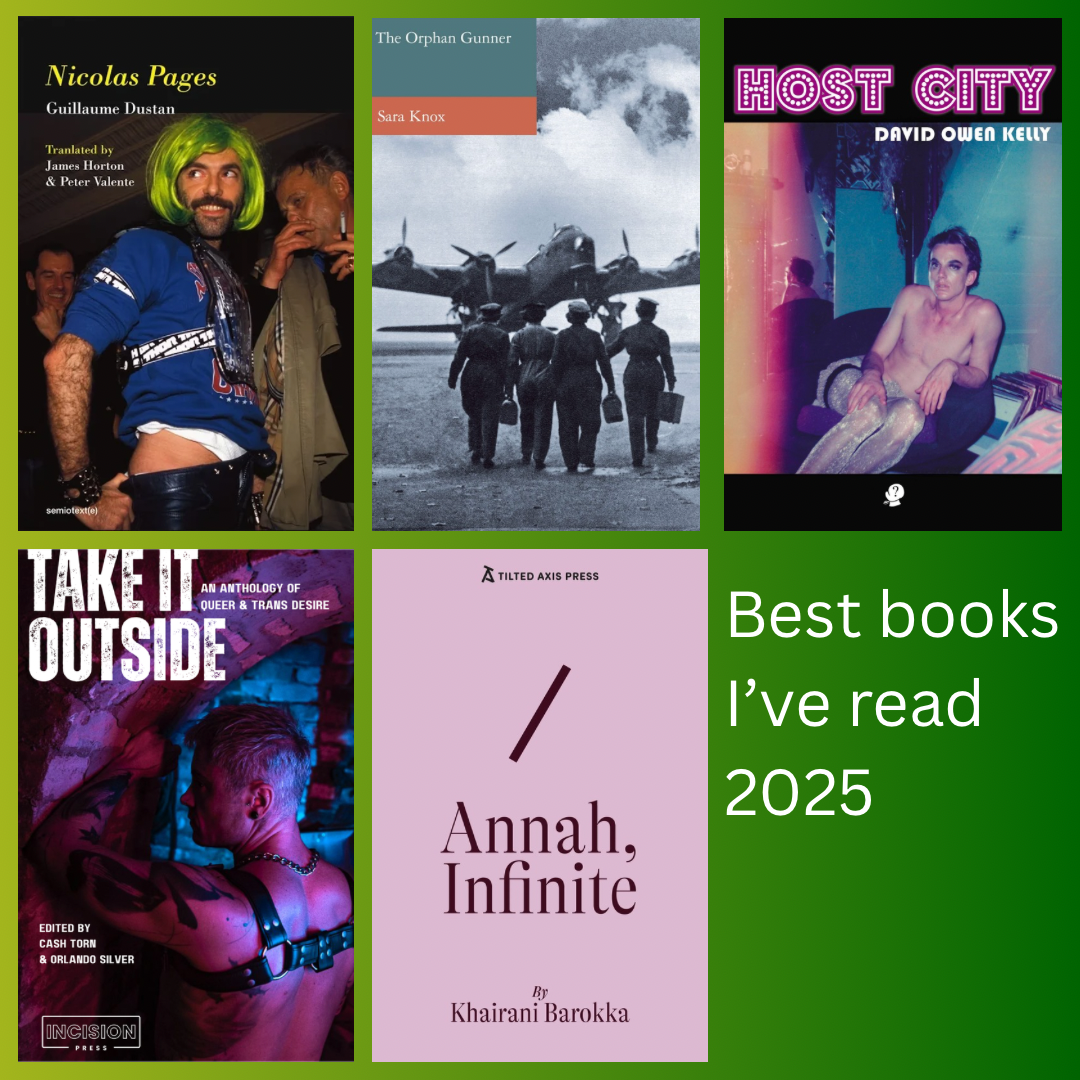
I’ve had a very gay year of reading. Maybe my gayest ever: of the 42 books I read, I rated 21 as Certified Gay. Unsurprisingly then, my favourite reads of the year are all queer. More on those after some other highlights.
For better or worse, many of these gay books were literally so: centred on the experiences of cis gay or bi men. I loved Both, Douglas Crase’s poetic double biography of botanist-artists Rupert Barneby and Dwight Ripley, and Neil Bartlett’s cultural analysis of Oscar Wilde in Who Was That Man?. I enjoyed the murdery-horniness of both Jean Genet’s original Querelle, and Kevin Lambert’s unhinged contemporary take on it, as well as Thomas Vowles’ Our New Gods, which continues the genre. And I soaked in the sweet-horny vibes of Holden Sheppard’s King Of Dirt and Darcy Green’s After The Siren. The debate over women and non-binary authors writing men-on-men romance reared its head once more thanks to the excellent TV adaptation of ice hockey romance Heated Rivalry; personally I love the implied fantasy of these stories, which at their best maybe even offer something for men to aspire to.
It wasn’t all gays though. I loved Torrey Peters’ genre-bending followup to Detransition Baby, Stag Dance, and making my way through Nino Haratischwili’s Georgian epic The Eighth Life I was delighted to find a queer love story at its heart.
I went to Japan mid-year, and enjoyed reading novels from the country’s past (Yasunari Kawabata’s The Rainbow — also queer!) and present (Tahi Saihate’s Astral Season, Beastly Season, arguably queer vibes).
I made a concerted effort to read some classics from Australian women writers this year: Shirley Hazzard, Thea Asthley, Gillian Mears (after reading her excellent biography by Bernadette Brennan last year; review to come) and Beverley Farmer, whose story A Ring Of Gold is an all-time great piece of writing.
Poetry-wise, Hasib Hourani’s Rock Flight (sorry for rating it not gay!), Bella Li’s Lost Lake, Andrew Brooks’ Inferno, and Raging Grace, a collaborative collection from disabled poets, all enthralled and provoked while doing that thing that only poetry can do, which is reshaping language for new purposes.
Two friends and former colleagues published outstanding, brilliant works of non-fiction this year: Jane Rawson’s Human/Nature and Megan Clement’s Desire Paths, both tackling borders (between us and nature, and national respectively). Elsewhere in non-fiction, Debra Dank’s new book Ankami is a harrowing confrontation with colonial violence in Australia.
Here are my top five:
Host City by David Owen Kelly — Host City starts as an astonishing portrayal of Sydney as AIDS emerges before taking a hard swerve into something more queasy and speculative, an electrifying fusing of myths medieval and modern.
Nicolas Pages by Guillaume Dustan (translated by Peter Valente and James Horton) — A blow-by-blow (in every possible sense) account of gay life in 1990s Paris, this fusion of memoir, diaries, essays, and at one point a space pig ballet can barely be described as a novel, but boy is it an exhilarating display of creative force.
The Orphan Gunner by Sara Knox — I have almost zero interest in the military specifics of history, but somehow, through her attention to the cost and feeling of war, this sapphic romance set among a women’s air company in WWII UK soars.
Take It Outside (edited by Cash Torn and Orlando Silver) — Barely a penis in sight, but plenty of cocks, this collection of trans and gender diverse erotica does exactly what it says as it expands the possibilities of sex and intimacy.
Annah, Infinite by Khairani Barokka (review forthcoming) —Barokka insists we see the possibility of pain and disability in this “translation” of Paul Gauguin’s painting Annah la Javanaisse — and shows that the denial of this possibility lies at the heart of domination: colonial, capitalist, white supremacist. You’ll never look at an artwork in the same way.
Discover more from The Library Is Open
Subscribe to get the latest posts sent to your email.
 The Library Is Open