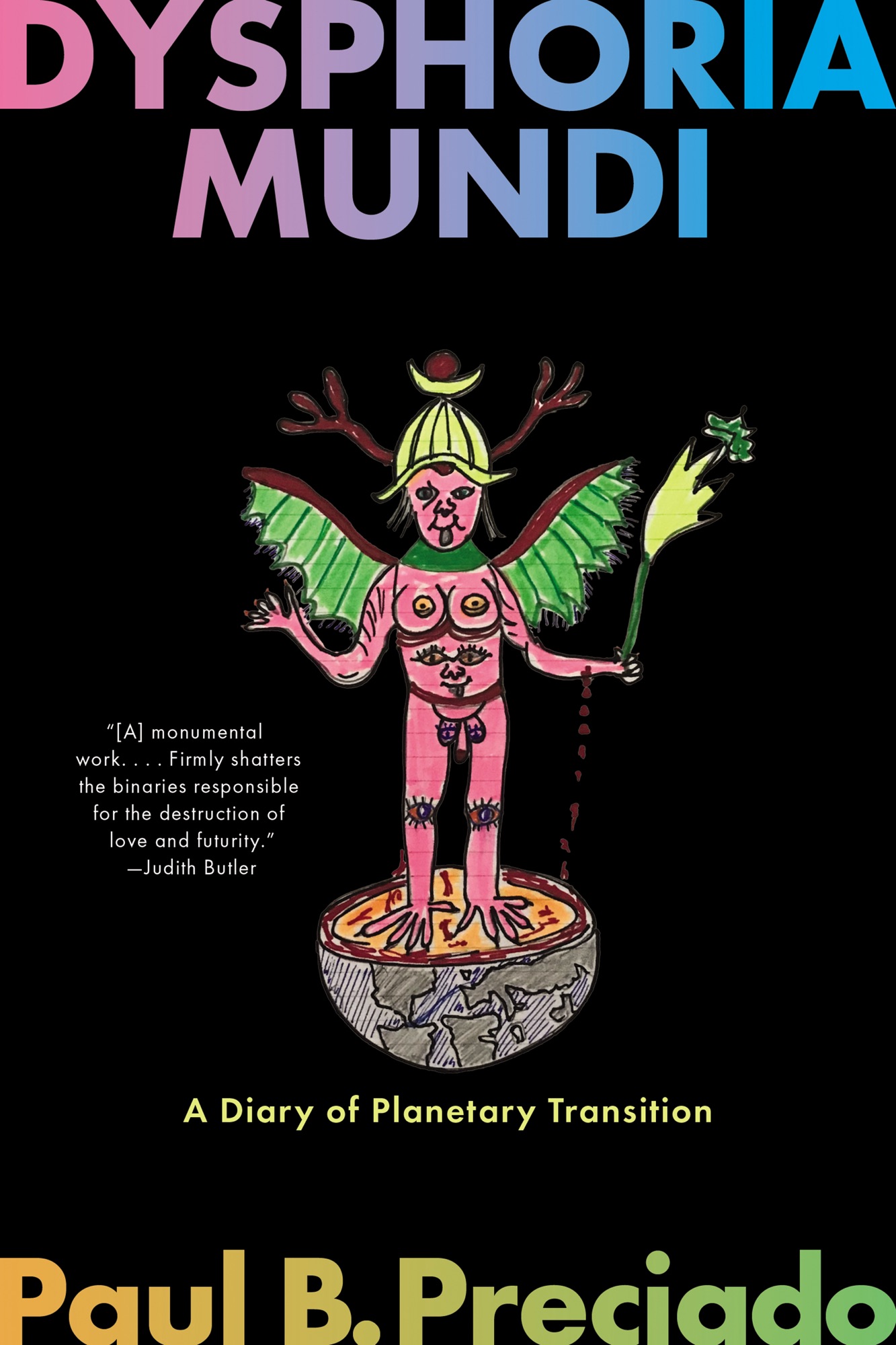
This book of contemporary philosophy — or as author Paul B. Preciado would have it, of “documentary philosophy”, is constructed of three sections. The first, Dysphoria Mon Amour, outlines the theoretical basis; the last, Letter To A New Activist expresses admiration, hope and words of encouragement for the next generation. The second, Dysphoria Mundi, forms the bulk of the work. This is written as a series of short meditations titled […] Is Out Of Joint, interspersed with poems, Funeral Prayers, for things like the environment, big tech, psychiatry. Each entry begins with the repeated paragraph of binaries that becomes something of a prayer or mantra itself:
Interior, exterior. Full, empty. Healthy, toxic. Male, female. White, Black. Domestic, foreign. Cultural, natural. Human, animal. Public, private. Organic, mechanical. Centre, periphery. Here, there. Digital, analogue. Living, dead.
Dysphoria Mundi, Preciado proclaims, is a “non-binary book”: “the book is, like the planet, in transition”. Being in transition themselves, as stated in Preciado’s medical history that sits at the opening of this book, they diagnose the rest of us. Preciado explains the conceptual history of dysphoria, meaning “difficulty carrying: it does not hold”, how it evolved into a medical diagnosis from psychoanalytical concepts like hysteria and melancholia. In making dysphoria a medical condition, it became something to be treated, with drugs, surgeries and other interventions. But Preciado is out to reclaim this condition as description for what can only be described as the global vibe. “I had to declare myself insane,” Preciado writes, in order to transition, but then, “I wanted to change, that’s all … I was attracted to something else, to a gender that did not yet exist”. For them, this tumultuous moment is an opportunity to mutate and to break the binaries that hold us separate from the world and each other.
An important question for such a book is, when did this moment start? Preciado offers a symbol: the incineration of Notre-Dame in April 2019, which “could be called capitalism, patriarchy, national reproduction, world economic order”. This they see as the true beginning of 2020, “a cannibal year”. Most of Dysphoria Mundi is borne out of the great contemplation that was forced on much of the world by the COVID-19 pandemic and the response to it. Through their own experiences Preciado constructs through diaristic entries how the pandemic has both exposed the forces that structure our contemporary lives and consolidated many of them: borders, truth, drugs, consumerism, homes, bodies, work, sex, politics, digital technologies, analogue technologies, the nation and the narrative. COVID-19 is a regime change, a charged moment of revolution and counter-revolution between the forces of what Preciado conceives of as “pharmacopornographic”, “petrosexoracial” or “necrobiopolitical” capitalism and what comes next. But, they also argue, “2020 will never stop beginning”. From Black Lives Matter to feminist protests in Chile, they see the pandemic as a grand and ongoing moment of raised consciousness that equally casts backwards in time to the AIDS pandemic, where they first heard the word virus, and which Preciado conceives of as another beginning of biosurveillance and pharmaceutical globalisation.
Dysphoria Mundi, then, is a theory of everything, an attempt to explain how we got here, why it sucks, and maybe what to do about it. This is something that many thinkers and writers in many different fields have attempted, such as writer Amitav Ghosh, anthropologist David Graeber and archaeologist David Wengrow, and artist and poet Khairani Barokka to name a recent handful. There are many common ingredients: a dating of the world’s troubles to somewhere between European colonialism and the industrial revolution; a critique of liberalism; a concern borne out not just of social and political ills but environmental catastrophe; and a conviction that the constructs of race, sex, gender, ability and class are not natural identities but political and economic prisons. Preciado’s innovation is to examine these constructs and histories through the lens of trans and queer theory, and result is spectacular and dazzling, overwhelming by design. It’s easy to get swept up in the fervour, which, if a marker of success, means Dysphoria Mundi succeeds epically. But questions remain: is COVID-19 the rupture Preciado makes it out to be? It may be too soon to tell. Is it really as simple as switching off (from pharmaceuticals, from digital tech, from the consumption of “dead capital and dead pleasure”)? Clearly yes, but the path to do so is rough.
Using the virus as a mutant metaphor, Preciado considers how immunity is constructed, “a privilege that released someone from the obligations shared by all”, an opposite idea to community, with duty. A virus is “intrinsically mutant, a negation of identity rather an identity in and of itself”. Preciado calls on us to mutate our identities but more importantly our desires. Whether possible or not, most importantly they make the effort seem fun:
homosexual practices, masturbation, ecosexuality, fetishism with ejaculation outside the vagina, the use of sex toys, and non-heterosexual orgies are highly recommended practices of political resistance.
On meeting a new lover in Corsica they describe inventing an “expanded and deidentified way of fucking” they call a “360”. “No border can be an obstacle to what is already a common destiny”, Preciado proclaims. Later, “the trans-cyborg insurgency has begun”. Playfully, earnestly, Dysphoria Mundi is an exclamation that the moment has certainly arrived, now it’s up to us what we do with it.
Gay rating: 5/5 for queer theory, sex, relationships and themes.
Discover more from The Library Is Open
Subscribe to get the latest posts sent to your email.


1 Comment