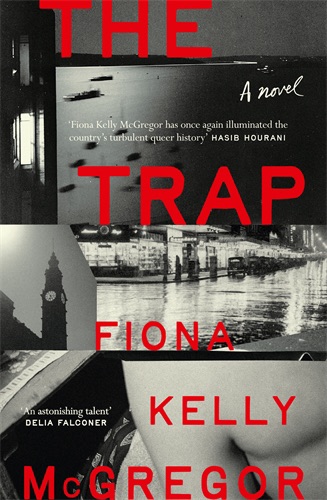
Fiona Kelly McGregor’s previous novel Iris gave us a real-life historical rogue to add to Australia’s queer pantheon, the story of Iris Webber, charged with murder in 1937 Sydney and even more notorious for her womanising. The Trap picks up half a decade later. Now, Australia is at war and the streets, which fall to pitch black during the night-time brown outs, are full of American GIs. Despite the change of times, people are still getting by however they can, a variety of odd-jobs like sex work, lurks, and sly grog, as Ray Sayles is at the beginning of The Trap. Former dancer and club-runner, we met Ray previously as the drag queen Black Ada in Iris.
Living with his lover Philly, Ray also pays sporadic visits to the cruising grounds of the waterside parklands. “Fear was an aphrodisiac,” he thinks of the possibility of Japanese invasion. Cruising the public toilets evokes a similarly enticing feeling:
what must I overcome today, what might I get away with, what will I have to navigate on my decent into the underworld?
It’s while cruising that Ray is arrested by cops from the local Vice Squad, and then that The Trap spills out into a fascinating exploration of a true scandal that embroiled the media (including a young Frank Packer) and justice system. To take us through this world, Kelly McGregor gives us the delicately interlocked perspectives of cops Carney and Grigg, lawyer Harold Munro, Packer and his journalists, and, delightfully, Webber once more, constructing a twitching house of cards set to tumble. The Trap is a counterpoint in structure, setting and theme to Iris, building to a hot and vital conclusion that implicitly poses an explanation for the imbroglio that has come before: when the joy of queer existence reveals the misery of hetero limitations, why wouldn’t they try to make it illegal?
In The Trap, Kelly McGregor exposes the fiction of criminalisation. Sayles and other men like him are charged under vagrancy law rather than sodomy laws, an arbitrary catch-all used to punish anyone deemed undesirable. “They’re keeping her inside anyway,” Iris says of another imprisoned woman, “It doesn’t really matter what for.” The Trap slyly takes us inside the perspective of law enforcement and power-brokers with psychological acuity and sleaze, like the officers in their office where “the sun lowered to reach deeper into the room like a hand crawling up a skirt”.
Like Iris, The Trap unfolds through a heady mix of the familiar and unfamiliar, where small details might suggest whole untold stories — like Munro’s collection of Japanese erotica from a 1936 business trip to Tokyo. This is a lived-in world, one that sits only just beneath the surface of our time.
Gay rating: 5/5 for characters, sex, relationships and themes.
Discover more from The Library Is Open
Subscribe to get the latest posts sent to your email.

