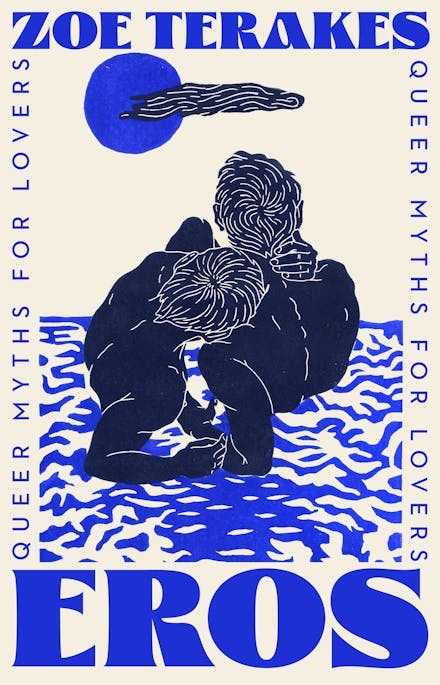
Here is another addition to the recent flurry of reinterpretations of classical myth. It is easy to understand the pull of such stories in their old tellings: they are bizarre, often thrillingly violent and gruesome, moral in familiar and enticingly unfamiliar ways. So what is added in their contemporary recreation? This collection demonstrates that there is still much to be gained.
In Eros, Terakes retells five myths. In Iphis And Ianthe and Icarus And Apollo, Terakes sketches in a classical setting with austere detail. Eurydice is notably contemporary, starting in a bushdoof before descending down the rabbit hole and crossing the Styx. Artemis And Kallisto, a highlight and the longest tale of the collection, begins in what seems to be undifferentiated History, but soon emerges into a very specific tale of 20th Century war and migration. The final telling, Hermaphroditus, takes place in 1980s or ’90s Sydney around the queer district of Kings Cross.
Subtitled Queer Myths For Lovers, Eros is indeed forthright about desire, rich in sensual detail, spilling over with Queer Yearning. “My cum is soaked into every seat on the T4 Illawarra to Eastern Suburbs line,” proclaims the titular character of Hermaphroditus, and then, “And still, no-one has fucked me better than Mahmoud’s knee pressed into mine”. Terakes transforms Icarus and his father’s desperation to escape into something even more fundamental:
Icarus had always loved the sun. The way he breathed colour into flesh and flower. His persistence. His tenderness … Icarus lay in fields and seas bathing in Apollo’s heat, branded by its gentle sting. Icarus’s home was where the sunlight was.
When Icarus and his father are imprisoned for doing their job too well (building the labyrinth in which to hide the Cretan king Minos’s monstrous offspring), Icarus longs for Apollo’s touch, and when he gets it, it’s more than earth-moving:
Icarus felt his own flesh scorch under a glow so white-hot that, had it gone on for a moment longer, Crete would have been nothing but cinders. It broke the humidity like a fever; the air was light again.
Eros’s attunement to nature invests characters’ desire with elemental force. When Artemi meets Kallisto surfing, she carves “long, wide shapes into the face of the wave, trying to write her name … Another wave, another conversation, another careful step towards each other.” Love, here, transcends space and time, it ascends to myth.
Terakes grounds their retellings in Cretan specificity. “Crete, the playground of the beast, Crete the graveyard, Crete the city of bones”, they write, lending these tales the shiver of an ancient-but-lived-in place, a place with a history outside of myth. This is given potency by Terakes’s exploration of the violence of patriarchy that shapes the lives of many of the characters here. Toying with gender, they seek a masculinity that is not ruinous, like Iphis’s desire for a male body:
I wanted the hair and the stench and the muscle, but I did not want the insides of a man…. Something angry and careless lurked within them … I watched them miss the intuition of living and mock the detail of loving.
No one is unchanged by the end of these stories; and often the transformations are brutal and grotesque. Terakes writes intuitively of becoming, such as Icarus’s conviction that “nature might bend to him”:
he was of that captivating and dangerous age where boys arrive in their bodies and become men, and the world blushes in response … He had a small feeling in his heart that he was at the very core of the earth’s turning.
In the old tellings, transformation is often punishment, or at least tragic, as characters are taken from their old lives. Here though Terakes offers a queer possibility, that transformation, mythical and otherwise, is a passage to freedom.
Gay rating: 5/5 for queer characters, themes, relationships and explicit queer sex.
Discover more from The Library Is Open
Subscribe to get the latest posts sent to your email.

