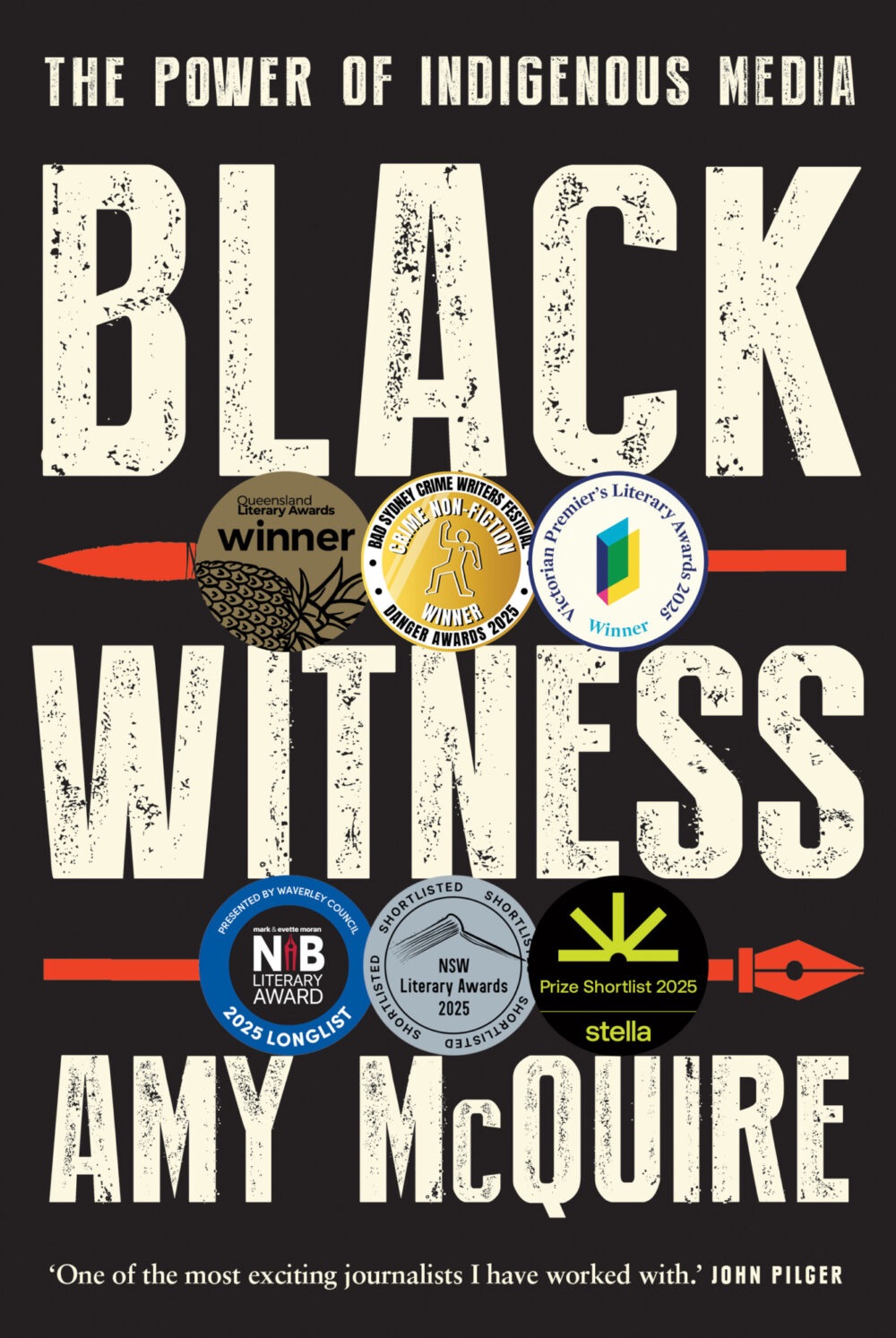
Australia’s media gets the story about Aboriginal people catastrophically wrong, Amy McGuire argues in this investigation. The first section, White Witness, begins with war and ends with disappearance. McGuire revisits communities where Aboriginal people have resisted colonial violence, only to find themselves depicted as violent by white journalists. For the white witness, McQuire writes, “all of history is a war”, and yet, oddly, the real war, the one against black people, remains unspeakable. On Palm Island, where community members rose up after the death in custody of Mulrunji Doomadgee in 2004, police said they had seen people carrying spears; a judge found no evidence that this was the case. For McQuire these imaginary spears represent the racist myth-making around Aboriginal communities: that they are violent, lawless, “depraved and disadvantaged”, “a place outside Australia” where journalists enter as “war correspondents”.
Perhaps no other community illustrates such myth-making as Mutitjulu in central Australia. In was here in 2006 that reports of sexual violence towards children were featured on ABC’s Lateline. Two weeks into her first job at the National Indigenous Times, McGuire traces the dubious and highly political origins of these reports to their catastrophic result, the Northern Territory Intervention which saw the government brazenly seize further control over Aboriginal communities. The concern about children is deeply ironic, McGuire writes, considering the violence Aboriginal children have been subjected to by colonial authorities, particularly in the removal of children from their families. McGuire highlights other convenient silences such the disappearances of more than 300 black women since 2000. In an excoriating chapter, McGuire dissects one such case, the disappearance of Lateesha Nolan and Kristy Scholes. The perpetrator, an Aboriginal man, lived on the run for nearly a decade, during which time he was lauded as something an outlaw until he shot a police officer. “Everyone was chasing shadows,” McGuire writes, but they were “the wrong shadows”.
Black Witness is a criminological book, a study of what violence is legitimate and what is not. Through her detailed investigation of white journalism, McGuire reveals how the media works, everywhere, not just when reporting on black stories. She makes visible the often invisible principles that shape journalism: newsworthiness, the assumption of audience, the closeness of journalists’ to state authorities. Indeed, McGuire argues, “journalists’ structured relationship to power means that they are not the primary definers of the event, but rather reproducing the interests of those in power”. Despite journalists’ insistence, the media is never neutral or objective; it is always a political and cultural construct. To read Black Witness is to have a mirror held up, and then to be taken through that looking glass into a topsy turvy world. These are not just problems of fact but disastrous for Aboriginal people. Considering the media as a tool of empire, McGuire deconstructs how it builds a narrative that furthers the erasure of Aboriginal sovereignty and enables the control of that most fundamental of resources: land. All of these processes are ongoing. Media coverage and political response to the death of Kumanjayi Little Baby in Alice Springs replicates many of the processes McGuire describes in Black Witness. No charges will be laid over police involvement in the death of Kumanjayi White in 2025. McGuire continues to report on black stories of injustice on her Substack.
What would another way of doing media look like? In the second section, Black Witness, McGuire offers a powerful counternarrative. Drawing on her own journalism across a number of different platforms, McGuire illustrates a different set of principles for reporting black stories. One of those principles is simply foregrounding the black voices, revealing the shocking absence of them in other parts of the media. Across similar stories included in the first section — deaths in custody, disappearances of women and children, accounts of police violence and injustice in the justice system — McGuire interviews family members, establishing relationships to community and culture. McGuire makes no claim to any false objectivity. “Our role in black media must be advocacy in favour of blackfellas,” she writes in the introduction, “Black journalism is never separated from activism”. In Black Witness, McGuire offers an alternative way of doing media. Its lessons would be well heeded.
Discover more from The Library Is Open
Subscribe to get the latest posts sent to your email.

