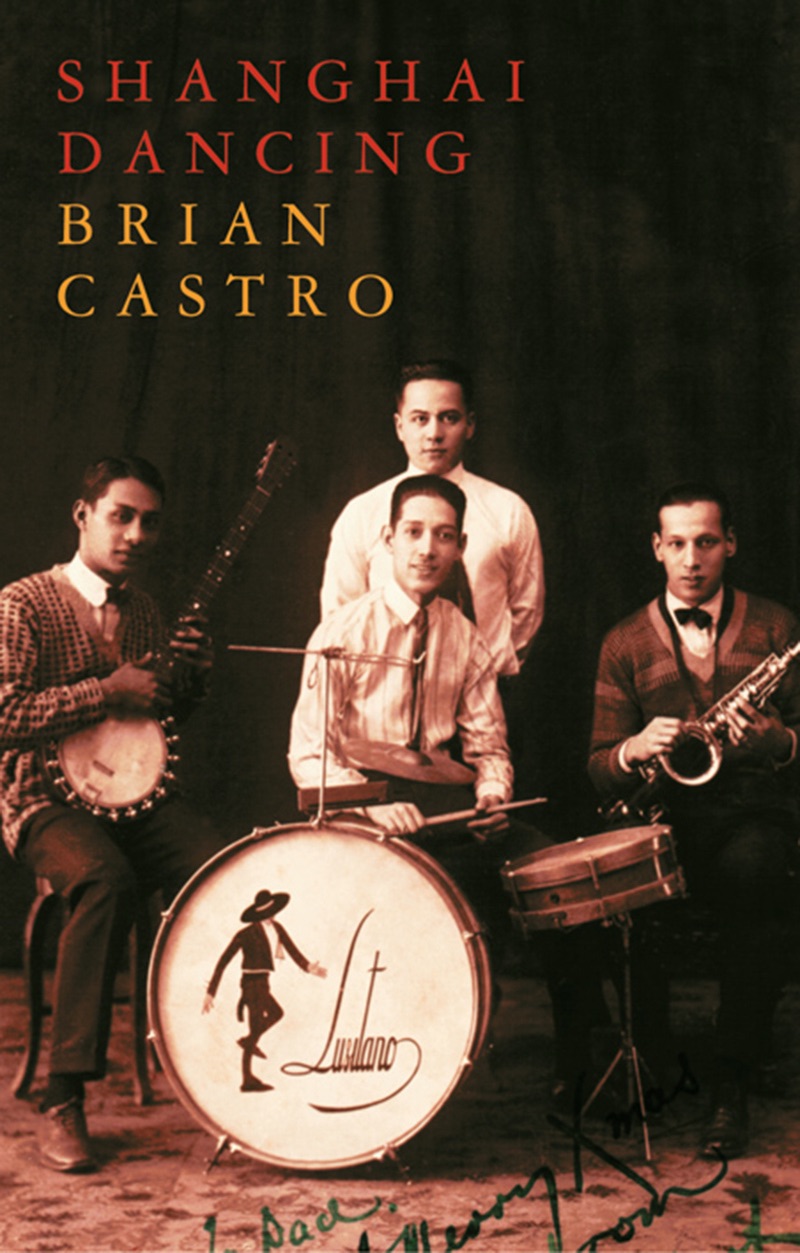
This peripatetic, searching novel begins with a birth, the narrator coming screaming into the world aboard a storm-heaving ship. Using all the tenses and persons — first, second and third — the narrator describes how he “had come the wrong way round and had descended into hell”. What the novel is searching for though will leave you on ground as unstable as a rolling ship.
One clue is the novel’s title. Shanghai-dancing, a phrase the narrator first heard his father say when he was little to describe his forays to the city’s bars and speakeasies where he would woo women. Not uncoincidentally, we also learn it’s a term for syphilis. This is at least one of our narrator’s inheritances, a penchant for beautiful women and his father’s advice to have several on the go at the same time, including a string beginning with C: Carmen, Cindy, Clavdia and Crystal. Another clue may be the sheaf of photos that our narrator holds as he wanders the streets of Shanghai, matching their scenes to those many years later. “Here there were once Roman arches and wrought-iron staircases, mosaics and fountains,” he writes. His father has recently died.
As our narrator, who we learn is Antonio (a family tree in the frontispiece is another helpful navigatory tool), physically wanders the novel’s present, his pen and his mind wander the past, tracing the lives of his ancestors. It is rich, extraordinary terrain, encompassing half a millennia and lands as far flung as Holland, Brazil, Japan and Australia. Theirs is a potted history of war, trade and religion, following merchants like Manalisay Osorio De Castro, who imported tomatoes and mangoes into Shanghai and so founded an empire, and missionaries like Antonio’s stalwart English grandmother Dora Siddle who arrived in China in the tumultuous years of warlords and revolution. Castro evokes encounter with vivid, heady prose (reminding us that to be shanghaied is also to be robbed):
In China, she was told, they steal everything that’s not nailed down. The wooden planks swayed beneath her feet. She lightened, as though she had already been robbed and the noise of the docks which deafened her gave her reason to believe in her levitation. So she saw only coolies of the most jaundiced and leathery disposition, and they moved in a haze of coal dust and coppery light, now and then breaking into song, a sustained and strained falsetto, when pulling at a cable or wrestling with canvas and capstan. They eyed her in her outdoor costume and she stared back blankly through misted spectacles at the sweating flesh, upon a back or torso whose humid sheen had forced a slight unease beneath her clothes. She would die here, she knew.
In the present, Antonio moves between cities in the mode of a flaneur. From Shanghai to Liverpool to Australia he follows rumours of a half-brother, and the question of his material inheritance, which draws in the gangsters of Macau. Much of the action coalesces around Hong Kong on the eve of handover in 1997 when he is in fifties, although rapid shifts between the great maritime metropolises of Hong Kong, Shanghai and Macau disorient until it becomes difficult to know which city one is in.
That is part of the point. “I was a bit of a disorientalist”, Antonio proclaims proudly early in Shanghai Dancing, forboding the disassembling mode of the novel, this “enterprise of obfuscation”. This is partly a story of futility: not just of the lives of its characters, but of story itself. Castro resists the grand narratives at every turn, especially in such rich potential fodder as the Japanese invasion of Shanghai and Hong Kong. A handful of mentions of Franz Fanon suggests this resistance’s decolonial purpose. “What does it mean to be civilised,” a character poses, “when we know it is the effiency of method … in killing”. The act of piecing together history, to create a narrative, whether familial or national, is especially futile in Shanghai Dancing; to translate something into words is to immediately begin to remove it from its essence. This distrust, this frustration with words’ limits and their power, is an inheritance that Antonio conceives as a kind of madness and traces to very furthest of his family’s branches. His father loathed poetry, its “bastard cognition” and “sensations that are not reasoned”. Antonio seeks the “transerene”, the “worlds that fall between translations”.
And yet. For all Antonio’s insistence on futility there is the existence of the novel itself, a triumph of careful language, spectularly layered sentences and dazzling wordplay that entertains, provokes and expands like Alexis Wright. Take for instance Catsro’s description of the eyepatch of Antonio’s Uncle Willy, “a kind of fig-leaf”, which takes us from the profane and banal to incisive characterisation:
I steal glances at this transplanted jockstrap, this eyeball bra, this leopard-spotted G-string and see there a laser-printed eye. Yes, visions where there were none. A joke, he says. The eye follows you around. But this is, I suspect, some kind of insect diversion. A warning. He’s keeping an eye on things.
This is the compulsion to create, “the divine songs which undertook the preservation of worlds”, “a rhythm to the rounds of empire and exploration, pogroms, inquisitions, revolutions and despair”. “Truth is not the seduction”, Antonio proclaims, “and sceptics can never know the wondrous pearling around that grain, above all, the swirl of narrative within these oyster-worlds”. In interludes described as a Pillow Book, the Japanese art of journalling, Castro writes:
For many years I have been consumed by voices which spoke to me … voices from rooms which precluded movement and light, rooms for the purposes of punishment and safety; voices which when freed from the dark, would spread malice and evil … It was for their own good. Now I had a wild and primitive intuition to heed what I heard: pleas, imprecations, sly flattery of my good nature; to free them in a kind of respiratory way.
This is writing as dance, like St Vitus’, “a pilgrimage towards the centre of expression … trying to find their way back to the hub of creation”. Perhaps this is Castro’s warning not to be distracted by the fireworks and keep our eyes on power and structure. But it is impossible not to become immersed.
Gay rating: 1/5 for a half-sister who runs off with the “Sappho of Surrey”.
Discover more from The Library Is Open
Subscribe to get the latest posts sent to your email.

