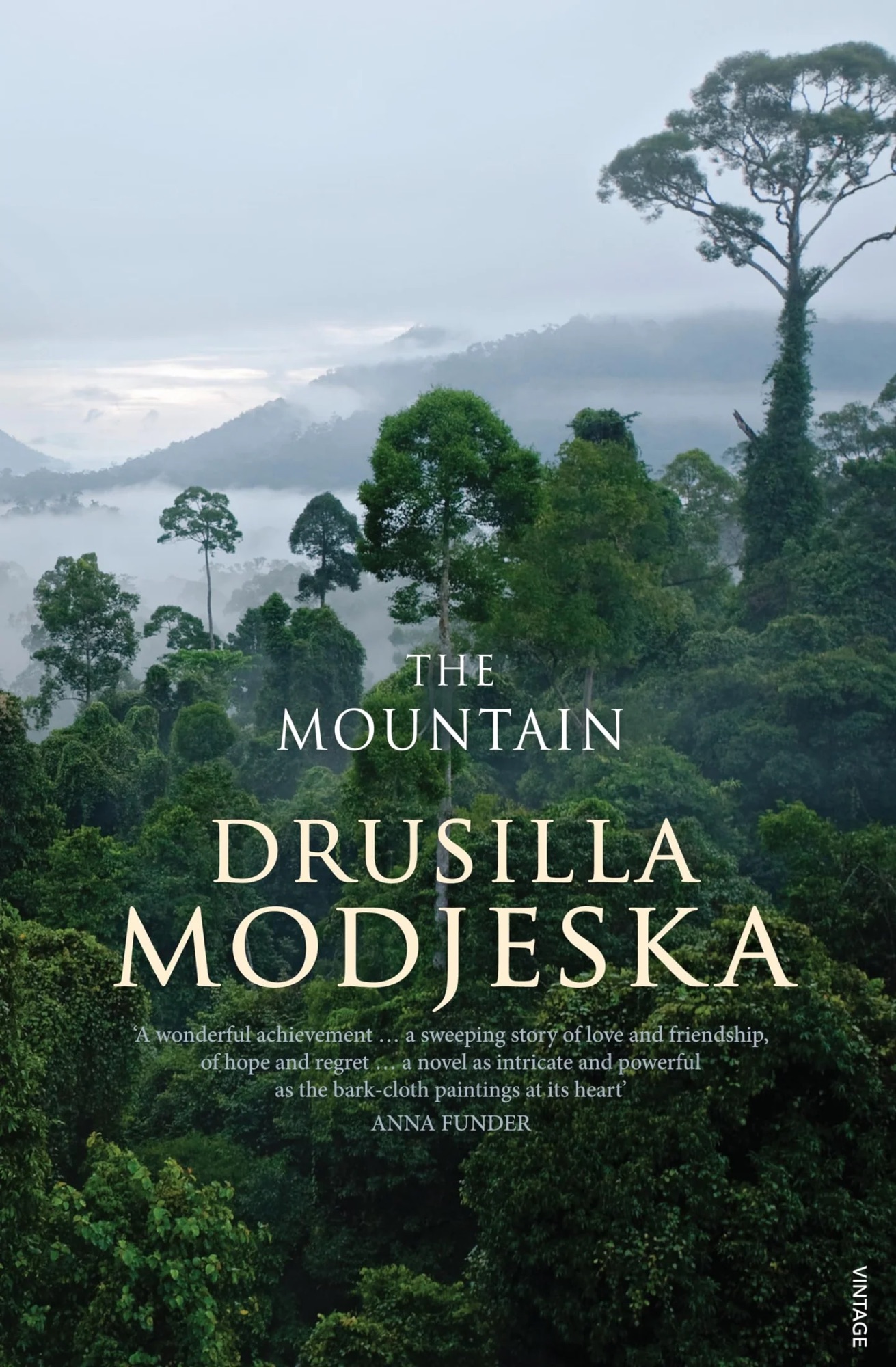
Kokoda — the word evokes a pivotal moment in Australia’s national mythmaking as much as the lives of those who were affected by it. In The Mountain, though, Drusilla Modjeska reminds us that Kokoda took place on land tended for millennia, and tangles the story of brave anti-imperial resistance with Australia’s own colonial ambitions: a brief mention of the execution of Papuans who collaborated with the Japanese army by the Australian military slices through this novel.
Here Kokoda is not the destination, but the starting point for a journey in the mountains, where villages create alluring bark-cloth artworks. Among the journeyers is 36-year-old Jericho, child of a Papuan mother and English father, whom we meet in 2005 in Sydney where this novel starts. Now a gallerist in London, he lunches with Martha, one of the mothers who raised him from five after he came down the eponymous mountain. There are depths of feeling, things unsaid, a strong undercurrent of ambivalence in their meeting. To find out why, we are returned to 1968 in Port Moresby, and the arrival of the Oxford anthropologist Leonard and his Dutch wife Rika. Leonard is in New Guinea to document the bark cloths on the mountain in film; Rika soon discovers her own penchant for photography. The white researchers wrestle with “the purity of observation”, or what Debra Dank might call the “telling gaze”, the air of false objectivity and distance that white people bring with colonisation. Rika ponders the seemingly irrisistible allure of New Guinea, particularly to the Surrealists like André Breton who said that Oceania “opens hearts”. The abject results of this seeing of New Guinea and the Pacific as a blank canvas to create upon, or as a “great experiment”, have recently been investigated by writers the likes of Khairani Barokka and Rachel Aviv.
1968 is a promising time for a novel set in New Guinea, with self-government and independence looming quickly. Modjeska carefully constructs the relationships and heady creative and political energy centred on the university campus in Port Moresby, where a new generation of thinkers battles it out for the future of the country. Among them is Aaron, from the fjords region of Tufi, who Rika is drawn to while Leonard is away on the mountain. When we meet some of this cast again 30 years later, as Jericho returns to New Guinea and the mountain, the threads that Modjeska has woven pull tight. Her prose moves fluidly from the mind to the material and place:
Alone in the house, [Jericho] takes another book from the shelves of rough planks … Baldwin again. Another Country. Jericho’s never read it. Mildew has formed behind the shelves, large black blooms of it. The concrete floor is damp, staining the woven mats, and the paint, long past its prime, is flaking. The house of an intellectual, Jericho thinks, and then doesn’t know what to do with the thought, which began with Leonard’s book-lined study, and peters out to nothing.He gets up and stretches, and when the school quietens and the classes begin, he walks down past it, skirting the classrooms and the offices, and takes the path to the river. He walks upstream to a place where the older boys swim … He takes off his clothes, wades into the water, feels the current and sun on his skin. Above him, a ripple of thin cloud against the blue, the whisper of trees. Birds.
Despite a character evoking A Passage To India, The Mountain is a bit less compelling on the machinations of empire than it is on interpersonal drama, and memory and its elisions. Modjeska focusses on the nature of exchange — of art, knowledge, power and in, the case of Jericho, a child. Is he a gift, as his village insists, a burden, an investment, or something else? How does responsibility and reciprocity work when structured by imperaliasm and capitalism, and is independence really the break from the past it seems or more of the same? These are ongoing questions — for a stunning and very current depiction, check out the documentary Sukundimi Walks Before Me, about vital community struggle to save the Sepik River from mining.
Gay rating: not gay, and one instance of transphobia
Discover more from The Library Is Open
Subscribe to get the latest posts sent to your email.

