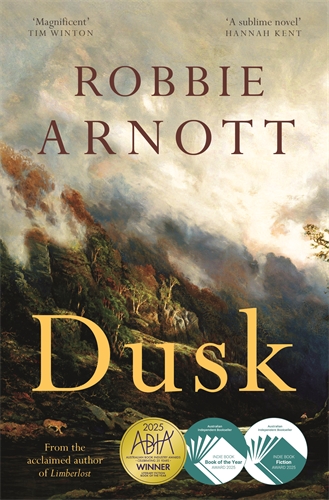
Late-30-something twins Iris and Floyd ride into the highlands on the hunt for a man-eating puma in this musing novel. Which highlands? They are Tasmanian-but-not, a similar alternative geography to Robbie Arnott’s second novel, The Rain Heron. There are wattles and currawongs and plains of buttongrass, but there are also peat harvesters and fossils of gigantic sea creatures littered across the plateaus. Also, pumas, brought in from Patagonia as some sort of biological control for the herds of deer that are rampaging across the land. The eponymous cat, Dusk, is said to be the last of her kind, after an extermination effort that followed the big cats’ preference for the local graziers’ livestock.
Arnott casts his net far and wide to construct this offbeat world: deer really are now rampaging across southern Australia; the country has a notorious history of biological controls gone wrong; Tasmania truly did have a predator persecuted with a bounty; and there’s our perennial fascination with the possibility that the bush is home to escaped big cats, the subject of novels the likes of Tim Winton’s In The Winter Dark and Adriane Howell’s Hydra.
Through this landscape the twins traipse, Iris increasingly drawn to the land around her, Floyd suffering chronic pain from an old injury. They meet the residents of the highlands, recruit assistance promising and dubious. The novel unfolds at the contemplative pace of a long hike before its inevitable climactic action. There is much to wonder at. The twins’ dependence and love for each other is drawn with tenderness. Arnott dials down the body horror that gave his earlier novels a sticky meatiness, instead here letting it prowl around the edges.
Dusk is also set in an alternative time. Iris and Floyd’s parents were transported for petty crime and lived an outlaw life. Graziers are expanding their hold and the land’s first people (styled without capitalisation in the novel) are being pushed to the margins, but this is not a place where genocide is obviously taking place. Instead, violence prickles below the surface. Arnott wrestles with what it means to love place, deeply. Wandering the highlands, Iris wonders at the “freeing, lung-emptying openness” and the proliferating tarns “each new body of water a strange delight”. She finds herself “slowly discovering the right way — or perhaps just her way — to move through an old world.” Later she tries to convince herself otherwise by considering the extractive potential of the land. She:
tried not the let the land affect her, tried not let its soft colours seep into her … it was bad country, she told herself, that couldn’t be grazed or ploughed.
This is rich terrain; so many of us are drawn to Australian landscapes that have been gutted of their custodians, this “old beauty haunted by new violence”. Dusk prevaricates over this moral dilemma for most of its length until its sudden concluding exclamation that rather too neatly addresses the problem of ‘bad’ settlers, while allowing ‘good’ settlers off the hook.
Most compellingly, Arnott continues an ongoing exploration of extraction. Many of Iris’s and Floyd’s memories revolve around the hunt: seals, timber, land. Like The Rain Heron, there is a cost to the hunt, a sacrifice to be paid, an idea of reciprocity that is more eye-for-an-eye than restorative. Dusk wonders what a relationship to nature could move towards that isn’t ruinous.
Gay rating: 2/5 for a major queer character.
Discover more from The Library Is Open
Subscribe to get the latest posts sent to your email.


1 Comment