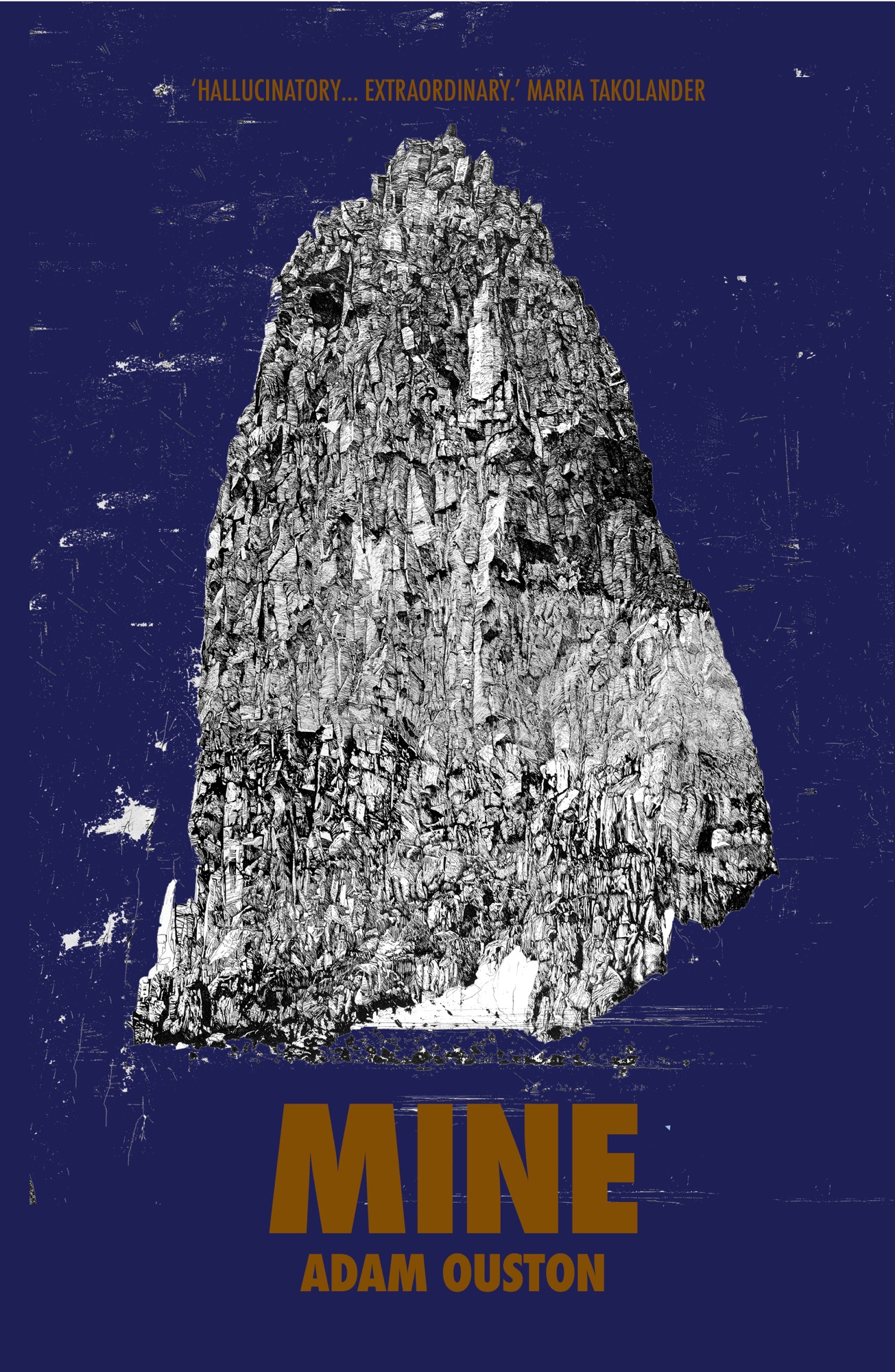
Is there something exceptional about Tasmania and its environment? It’s a question posed and seemingly defended in this tricky novel, which comes howling out of a hole in the state’s Wild West. That hole is the abandoned mine shaft that the nearly-70 poet-narrator has ended up at the bottom of, whether pushed or fallen is unclear. Coming to in a world of pain, like an animal in a trap, “bone-shattering but not quite fatal”, he is accompanied only by his thoughts and the inviting dripping of water into an underground font. Like Richard Flanagan’s Death Of A River Guide, with its protagonist entrapped in branches amid a fast-rising river after a kayaking accident, Mine derives its narrative tension mostly from the question of its narrator’s survival or ultimate perishing.
Also like Flanagan’s early novels — particularly Gould’s Book Of Fish which Ouston references directly — Mine is an exploration of the Tasmanian condition. Or rather, it is an excavation. Our poet has found himself on the West Coast in pursuit of the of the idea of writing a hauntology, “what isn’t there”. To do so, he locates once prosperous mining towns now abandoned to the rainforest, including Chester, site of the state’s worst mining disaster in 1912, when 42 miners died after a pump caught fire. They are “the human tailings of industrial production”, Ouston writes:
they had come to this incongruous, inhospitable, unknowable landscape from all corners of the world, fed on the offerings of the sulphurous flora and fauna, breathed the dusty air, before sickening, losing productivity, and being swept aside for a fresh batch of workers who followed in their broken footsteps, took their jobs, their tools, their wives, while they clung to life with twig fingers without nails
Like Ouston’s previous novel Waypoints, and similarly constructed of one long sentence that meanders and searches like a thought, Mine casts its informational web wide, this time drawing in the other major southern disaster of time, Mawson’s deadly expedition to to the far side of the Australian Antarctic Territory that saw his two companions perish. Like Robbie Arnott, there’s a pulpy horror to the novel’s fascination with the macabre, including the zombie-like undead of Chester, wandering the streets “as though they’d had their eyes plucked out, one-two, one-two, by stalking ibises or curlews”.
Ouston’s novel is most compelling as a psychological portrait. The poet — also “university lecturer … bushwalker, activist, old, so old, he was also miserable”, or more amusingly “cartographer of sighs” — is a note-perfect Tasmanian archetype, railing against greed and extraction, in protest of which he has been imprisoned multiple times. Trapped in the underworld, the poet reaches with increasing grandiosity for Tasmania’s environment, “the shadowy, eccentric part of the world, fathoms from anywhere”. By extension, Tasmania comes to represent the South, the upside down and great Antipodean unknown that so puzzled the earliest cartographers. In Antarctica, a junket to which inspired the poet’s quest 10 years earlier:
birds dove like comets on the gales, and a monster albatross passed so near to the poet that he felt the wing of death like wind within wind, the encounter having the negative atmospheric effect of drawing all the air from his lungs and he had to retreat to his cabin and lie down
This is land that is alive, the West Coast closing “around him with its leering, leery dark-green giants and its trick mists”. It is moral, even if its morals are unfamiliar; Amitav Ghosh has argued for the political use of a return to this kind of vitalism. The poet comes to see the land as writing through him, and he as its scribe:
it was sound that came to him, not so much like music as rhythm … it came fluting up like the assorted sounds from abandoned mines, and the words did the best they could to match or mimic the booming, creaking, and crumbling
But all this comes merely to seem as a distraction to the question that so fascinates the poet: what isn’t there? Tony Hughes-d’Aeth has made the case that Konrad Muller’s recent Tasmanian novel, My Heart At Evening, is about, through a perhaps-too-successful act of narrative erasure, the historical silence around the colonial genocide of Tasmanian Aboriginal people. Ouston’s narrator is even more silent on this cataclysm, one that arguably marks the island as exceptional. Instead, Mine poses intriguingly that such a character is not so dissimilar from the former mining tycoons that enriched themselves from the earth itself while emmiserating their workers. “They loved among it more intensely than he did,” the poet thinks of miners and foresters, “Was it a brutal, complex sort of love?” “You speak you name you own, mine”, he recites in this tale of men who tramped a supposedly untended land and named and claimed it for themselves. Did such an attitude end simply because some of those men started to rail against the digging it up and cutting it down? Tasmanian environmentalism, like the environmental movement more broadly, has had a complicated relationship with First Peoples’ sovereignty, notably in its defense of “wilderness“. In Mine, it’s left to us to figure out what the darkness is saying.
Gay rating: not gay.
Discover more from The Library Is Open
Subscribe to get the latest posts sent to your email.


I really liked Waypoints, so I’m looking forward to reading this one.
LikeLike